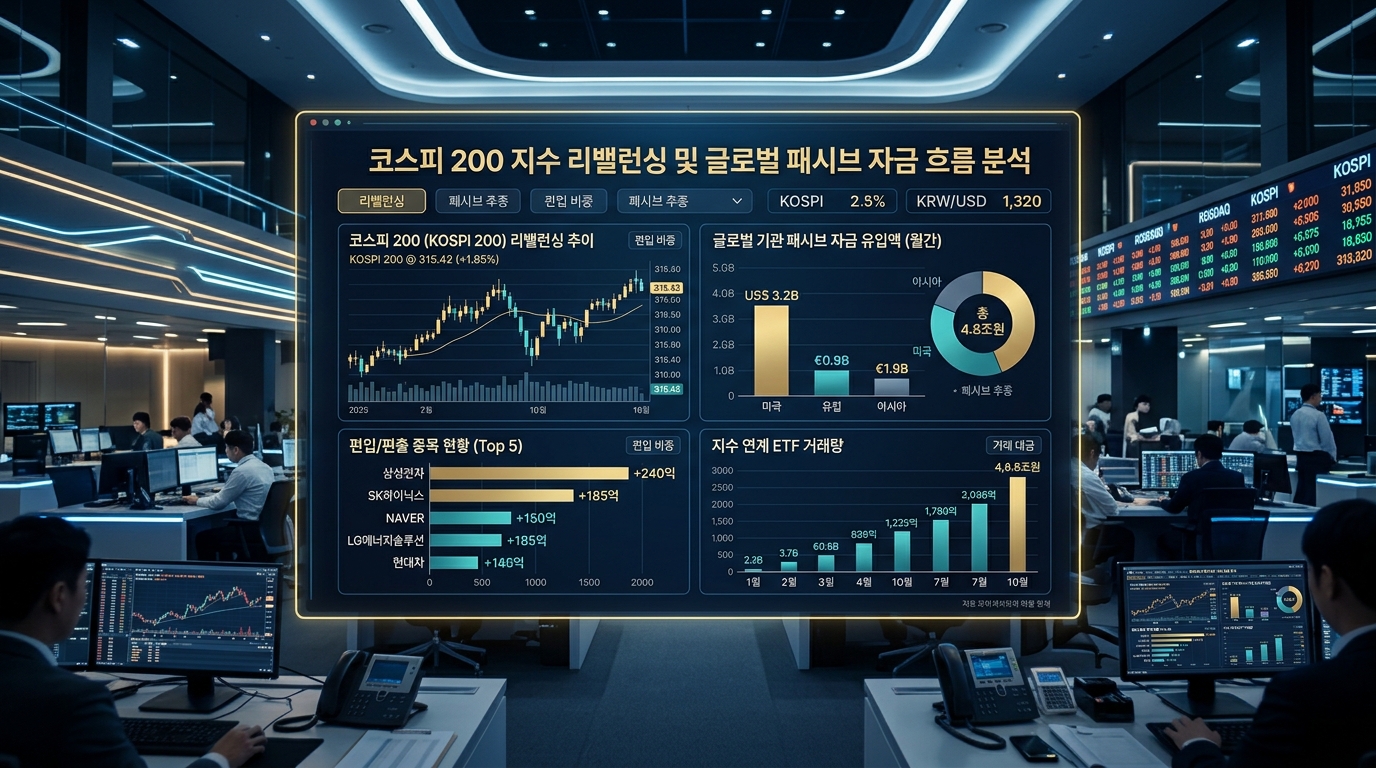
Hello, this is Daily Stock, delivering practical insights into macroeconomic trends and index rebalancing supply-demand dynamics.
Key Summary
The screening window for the KOSPI 200 regular rebalancing, scheduled alongside the simultaneous futures and options expiration on the second Thursday of December, enters its final stretch at the end of October.
Based on daily average market capitalization and turnover gathered from May through late October, candidate additions are taking shape. Market attention is heavily focused on the volume of mechanical buying from passive funds.
Amid exchange rate fluctuations around the 1,324.70 won level and ongoing supply-demand battles across traditional mega-caps like semiconductors and automakers, index rebalancing acts as a major watershed shifting individual stock flows.
From an investor standpoint, it is essential to prepare scenario-based responses that calculate the time lag between front-running active flows before the official announcement and foreign passive buying executed on the rebalancing date.
Current Market Context
Following the close of the regular domestic market on October 27, 2026, the KOSPI index stood at 5,638.34, while the KOSDAQ settled at 743.83.
With the U.S. NASDAQ index printing 26,169.38, the USD/KRW exchange rate closed at 1,324.70 won, reflecting sustained caution across currency markets.
Daily Stock's proprietary Fear & Greed Index shows the KOSPI at 'Extreme Fear (9.5)', following last week's 'Extreme Fear (6.7)' reading, underscoring deeply suppressed investor sentiment.
This index, which stood at 'Neutral (55.3)' one month ago and 'Extreme Fear (12.5)' three months ago, measures comprehensive data across implied volatility, RSI, and trading momentum rather than simple index movement.
Meanwhile, the NASDAQ Fear & Greed Index remains in the 'Fear (27.1)' zone, continuing its cautious trend compared to 29.6 a week ago, 36.9 a month ago, and 37.3 three months ago.
Foreign investors, monitoring whether the USD/KRW rate settles firmly in the 1,320-won range, are maintaining conservative positions—hedging index direction in futures rather than taking aggressive spot equity exposure in mega-caps.
| Category | Screening Criteria & Conditions | Expected Flow Dynamics | Estimated Impact |
|---|---|---|---|
| **KOSPI 200 New Addition Candidates** | Meets within 85% cumulative sector market cap during review (May–Oct) | Mechanical buying from global/domestic passive funds and index ETFs | Concentrated inflows equivalent to 150–300% of average daily turnover |
| **KOSPI 200 Exclusion Candidates** | Lower sector market cap ranking; fails retention threshold | Mechanical selling and position trimming by passive funds | Short-term selling pressure and index-tracking outflows |
| **Existing Large Components** | Top weights in the index (semiconductors, autos, financials, etc.) | Minor marginal trimming due to capital reallocation to new constituents | Impact is extremely limited due to diversification effect |
Financial Analysis
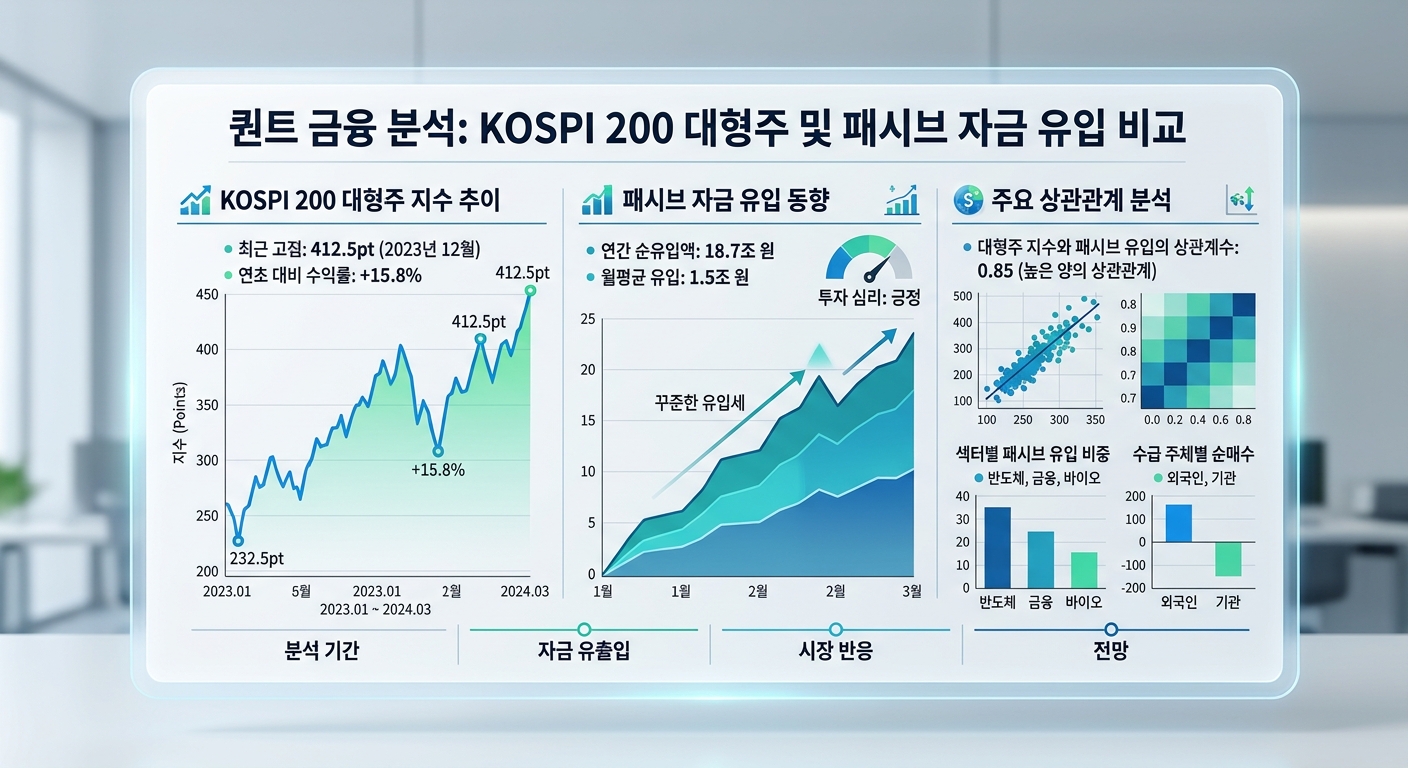
While market capitalization and trading liquidity serve as the primary screening thresholds for KOSPI 200 inclusion, underlying financial fundamentals—operating performance and free cash flow (FCF)—remain essential foundation pillars.
Analyzing the financial health of prospective candidates reveals that firms sustaining stable balance sheets near 100% debt-to-equity alongside topline growth have successfully protected share prices throughout the review period.
In particular, to cross the 85% sector market cap threshold in industrials, materials, and consumer staples, companies have generally sustained operating profitability and demonstrated progressive return on equity (ROE) improvements.
Conversely, existing components burdened by mounting debt and chronic operating losses have slipped in market cap rankings, failing to meet the retention threshold (within 110% of component count) and facing deletion risks.
While passive managers do not make subjective judgments on company balance sheets, active funds front-running these additions clearly prioritize fundamentally sound candidates.
Valuation
The broader KOSPI's 12-month forward price-to-earnings (P/E) ratio remains in an undervalued band of 10x to 11x compared to global peers.
The large-cap KOSPI 200 index enjoys strong downside support from semiconductor leaders like Samsung Electronics and SK hynix, along with low-PBR 'Value-up' plays such as Hyundai Motor and KB Financial Group.
In contrast, mid-cap candidates expected to clear the December screening trade at an average 12-month forward P/E of 13x to 16x, demanding a modest valuation premium over traditional large caps.
While the Korean market as a whole appears attractively valued compared to the S&P 500 trading above 20x, sudden pre-inclusion price run-ups in mid-caps can create valuation strain.
Valuation multiple expansion driven purely by one-off passive liquidity runs the risk of a sharp post-inclusion multiple compression, requiring close scrutiny of deviations from fundamental earnings power.
Expert and Institutional Insights
Quantitative analysts at domestic brokerages anticipate swift positioning from institutional capital targeting addition candidates once late-October trading data concludes and before the Korea Exchange's official mid-November announcement.
According to financial industry estimates, domestic and international passive capital tracking the KOSPI 200 (including index funds, ETFs, mutual aid associations, and pension fund mandates) exceeds 80 to 90 trillion won.
These massive tracking assets are mandated to mechanically purchase anywhere from tens of billions to over 100 billion won per stock, proportional to their designated index weightings.
Historical analysis highlighted by market specialists demonstrates that excess returns generated from index inclusion strategies tend to peak between the review conclusion and the official announcement date, rather than on the effective rebalancing day itself.
Because foreign passive funds typically execute their closing auction buys in bulk on the futures expiration day, analysts warn these flows often clash with profit-taking supply from earlier active entrants.

Risk Factors
The primary structural risk in KOSPI 200 inclusion plays lies in the sudden 'sell-the-news' effect and short-term supply distortions immediately after the effective date.
Following the December expiration day when actual rebalancing takes place, passive buying disappears abruptly, frequently triggering a post-inclusion retreat as shares peak.
Furthermore, newly added constituents become eligible for expanded short-selling mechanisms, introducing an additional layer of potential volatility.
From a macroeconomic perspective, if the USD/KRW rate continues to climb and exerts further downward pressure on the won, broad foreign basket selling across the entire KOSPI could completely overshadow individual stock inclusion tailwinds.
Additional risk variables placing downward pressure on index sentiment include the Bank of Korea's upcoming rate path, the Federal Reserve's restrictive stance, and potential export momentum slowdowns in the fourth quarter.
Investment Perspective
Heading into late October, portfolio strategies leveraging the KOSPI 200 rebalancing should rest on two core principles: identifying high-probability inclusion candidates and establishing a clear exit timeline.
Rather than chasing stocks simply because they may enter the index, investors must calculate the liquidity Impact Ratio—comparing anticipated foreign passive inflows against a stock's average daily turnover.
Liquidity-constrained names where expected passive flows equal multiple days of trading volume frequently exhibit sharper price elasticity leading up to the formal announcement.
Conversely, from the confirmation announcement through the close on rebalancing day, adopting a conservative target return and treating the concentrated closing auction liquidity as a phased profit-taking window represents a prudent approach.
With market sentiment entrenched in 'Extreme Fear,' investors should selectively manage exposure, favoring candidates fortified by sound valuation support and third-quarter earnings stability even within an event-driven framework.
Investment Checklist
- [ ] **Finalize Screening Data**: Verify final inclusion probabilities based on cumulative trading metrics from May through the final trading day of October.
- [ ] **Calculate Supply Impact Ratio**: Evaluate projected passive buying volume relative to the stock's standard average daily turnover.
- [ ] **Monitor FX and Foreign Flows**: Track USD/KRW trajectories alongside foreign positioning in KOSPI 200 futures.
- [ ] **Assess Post-Inclusion Risks**: Prepare for potential short-selling activity and profit-taking once the second-week December rebalancing wraps up.
- [ ] **Verify Fundamentals and Valuation**: Ensure the company possesses valuation floors and downside resilience independent of passive index flows.