Hello, this is Daily Stock, pinpointing inflection points across macro and industrial cycles.
Key Summary
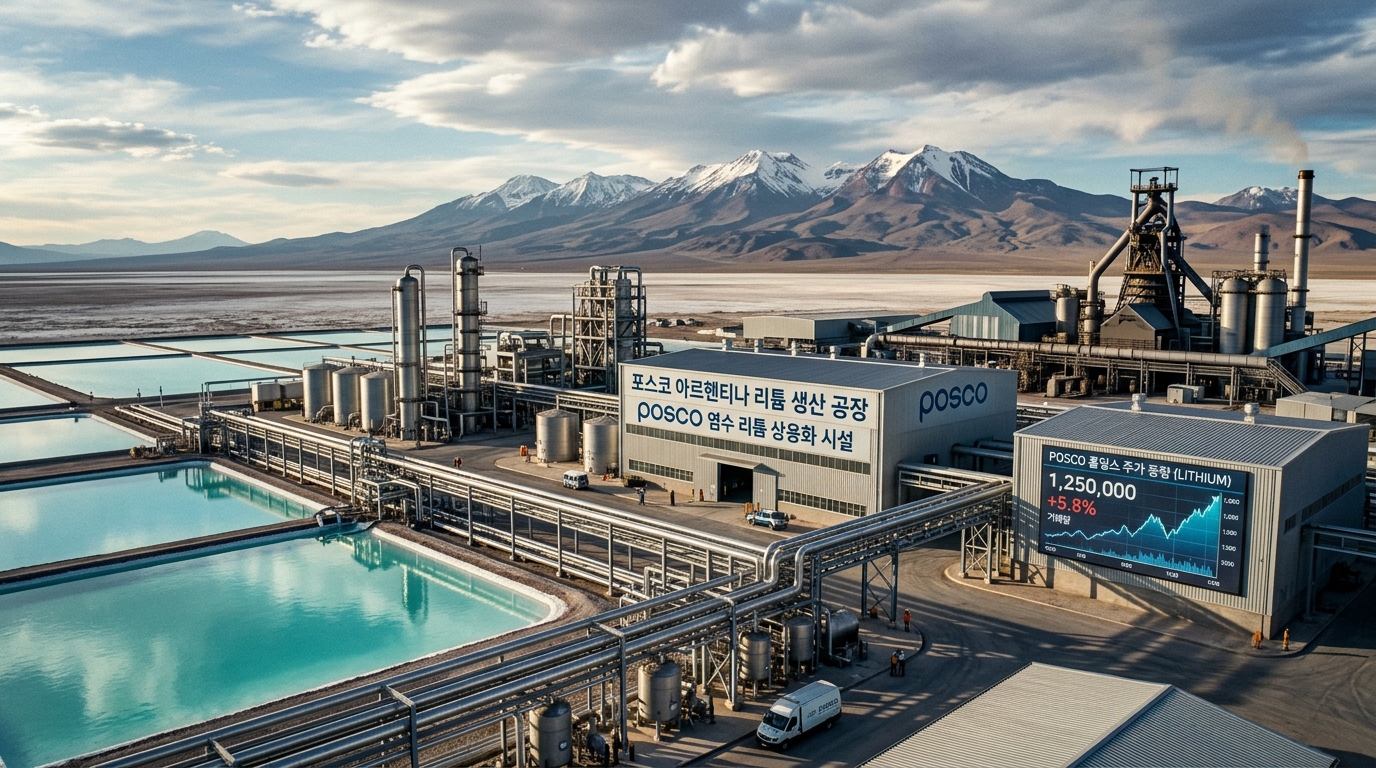
POSCO Holdings has completed the upstream construction of its second lithium brine plant at the Hombre Muerto salt flat in Argentina, bringing it on the verge of establishing a 50,000-ton annual lithium hydroxide production framework.
This plant serves as a strategic hub linked to downstream facilities in the Yulchon Industrial Complex in Jeonnam, driving complete internal supply-chain integration for core battery materials.
In its core steel business, potential roll margin (spread) rebounds are emerging in Q4, supported by stabilizing global raw material prices and China's production curtailment stance.
However, with the prolonged construction slump and persistent import pressures, pricing power defense and process efficiency will be critical tipping points for defending year-end earnings.
On the external front, under macro conditions of KOSPI at 5,550.30 and the KRW/USD exchange rate at 1,326.90, foreign investor fund flows are dictating the re-rating pace across large-cap value stocks.
With our proprietary KOSPI Fear & Greed Index lingering at 7.1 in the "Extreme Fear" territory, a phased approach anchored in mid-to-long-term resource monetization rather than short-term momentum is required.
Current Status Overview
On October 6, POSCO Holdings successfully completed upstream construction of its 23,000-ton-per-year lithium brine Plant 2 in Argentina.
Combined with the existing Plant 1 (25,000 tons), POSCO has secured a local production capacity of 48,000 tons of lithium carbonate in Argentina alone.
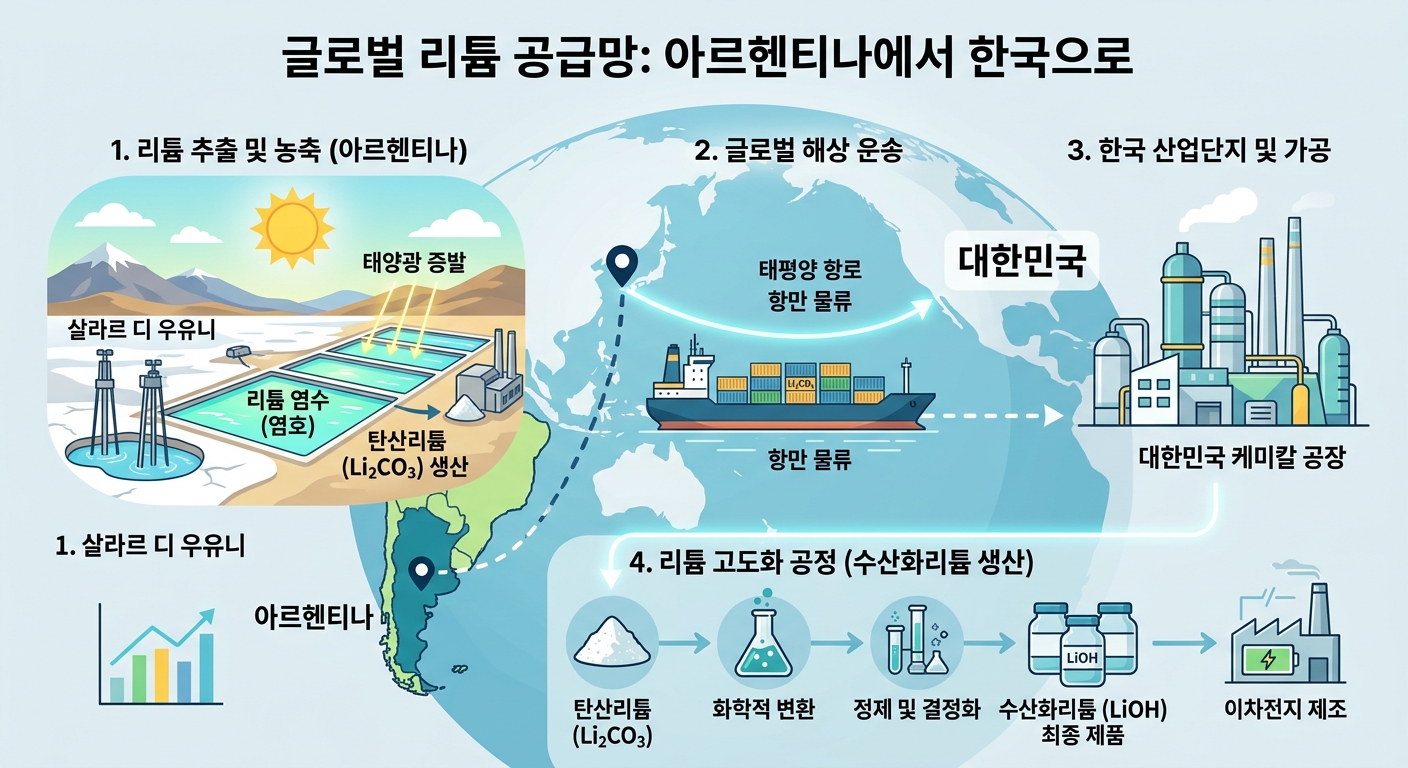
The lithium carbonate extracted and initially processed on-site will be transported to downstream facilities under construction at the Yulchon Industrial Complex in Jeonnam to be converted into high-purity lithium hydroxide.
Analysts evaluate this as clearing the first major hurdle in shifting an eight-year large-scale Capex cycle into commercial operation following the acquisition of the mining rights.
Despite sluggish downstream industrial demand, the steel division is supporting baseline earnings by expanding the proportion of high-value-added products at its Pohang and Gwangyang steelworks.
The gentle downward stabilization of primary raw material prices, such as iron ore and coking coal, is forming a technical baseline for spread recovery in Q4.
On the trading day (2026-10-25), markets were closed for the weekend, leaving prices "unconfirmed for the day (based on latest verified value)," with the recent share price fluctuating near the lower end of its range around KRW 310,000.
As buying interest concentrated on semiconductor leaders like Samsung Electronics and SK Hynix, as well as Value-up financial names like KB Financial, large-cap steel and materials stocks have experienced relative liquidity neglect.
Financial Analysis
POSCO Holdings' consolidated financial statements have seen operating profit margins temporarily pressured by the steel downturn and initial operational expenses from secondary battery subsidiaries.
Nonetheless, robust operating cash flow from the energy and infrastructure segments, alongside a virtually debt-free holding company balance sheet, continues to buffer Capex burdens.
In the second half of 2026, the company is prioritizing cash liquidity through non-core asset sales and restructuring low-profit subsidiaries.
With the debt-to-equity ratio stably maintained around 60% to 70%, POSCO is evaluated to have sufficient financial stamina to absorb working capital burdens during the ramp-up phase of new lithium production lines.
| Classification | 2024 (Confirmed) | 2025 (Confirmed) | H1 2026 (Cumulative) | Q4 2026 (Outlook/Check) |
|---|---|---|---|---|
| Consolidated Revenue | Approx. KRW 77.127T | KRW 69.095T | Around KRW 35.500T | Monitoring steel shipments and gas sales strength |
| Consolidated Operating Profit | Approx. KRW 3.531T | KRW 1.827T | Around KRW 1.100T | Testing roll margin recovery and lithium cost absorption |
| Operating Profit Margin (OPM) | 4.6% | 2.6% | 3.1% | Attempting to settle in mid-3% range |
| Core Drivers | Slowing steel spreads | Downstream demand slump and subsidiary costs | Cost control and infrastructure profit defense | Argentina Plant 2 operation and easing China supply-demand |
Thanks to fixed-cost reduction efforts, standalone steel earnings have passed their trough and are entering a gradual recovery track.
However, on a consolidated basis, initial overheads including depreciation expenses from POSCO Future M and the Argentine lithium entity continue to act as offsetting factors.
Valuation
Currently, POSCO Holdings trades at a price-to-book ratio (PBR) of 0.4x to 0.5x, resting at the historical lower bound of its band.
This corresponds to the extreme undervaluation valuation zones historically observed during major steel downcycles in POSCO's history.
Compared to KOSPI 200 large-cap value peers, it resembles the low valuations of automakers like Hyundai Motor and Kia, yet the delayed turnaround in the steel cycle is reflected as a discount on its ROE recovery resilience.
Conversely, relative to global lithium pure-plays (such as Albemarle, SQM), possessing steel as a formidable cash cow offers a structural relative advantage that caps downside risk.
It also trades at a pronounced discount to EV/EBITDA multiples of global steel peers like Nippon Steel and ArcelorMittal.
A multiple re-rating as a materials holding company remains an open possibility once commercial lithium shipments materialize into reported earnings.
Expert and Institutional Analysis
Domestic and foreign brokerages and credit rating agencies interpret the completion of Argentina Plant 2 as a pivotal milestone for long-term resource security.
However, with spot lithium prices searching for a solid bottom, they caution that initial fixed-cost burdens could have a neutral to negative impact on near-term quarterly earnings.
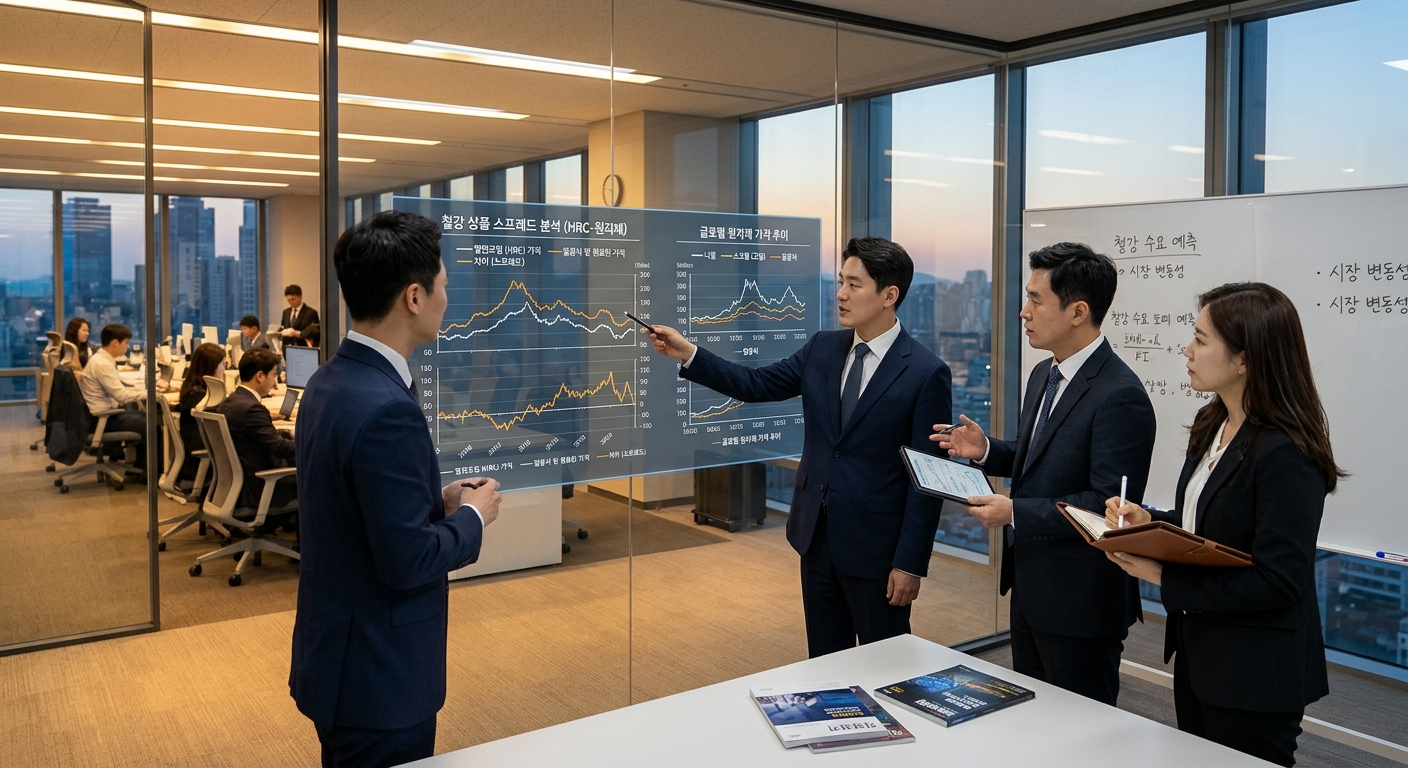
Regarding steel spreads, the actual enforcement intensity of Chinese real estate stimulus and production curbs is viewed as the primary yardstick.
Major domestic equity research desks analyze that hot-rolled and cold-rolled spreads have room to improve by KRW 10,000 to 20,000 per ton starting around November–December, when lower coking coal prices are reflected in input costs.
Foreign institutional investors appear to have halted mechanical net selling in the cash market, probing possibilities for short covering and bottom-fishing for dividend yield.
Prevailing views suggest that a shift toward Korean won appreciation from the current KRW/USD 1,326.90 level could trigger a resumption of foreign passive inflows into large-cap materials names.
Risk Factors
The most immediate risk is a delayed rebound in lithium carbonate and hydroxide prices due to the prolonged EV "chasm" (temporary adoption lull before mass-market transition).
If ramp-up rates at newly completed facilities in Argentina and Yulchon rise slower than anticipated, fixed-cost burdens and depreciation could erode consolidated holding company operating profit.
In the macro sphere, another spike in the USD/KRW exchange rate and intensifying global protectionism could weigh on steel export profitability.
A delayed pace of rate cuts by the Bank of Korea would prolong domestic housing and construction stagnation, impeding demand recovery for long products and domestic sheet steel.
Global steel overcapacity also persists.
If China's domestic economic recovery lags, dumped exports of low-cost Chinese steel into Southeast Asian and Korean markets could continue to constrain domestic distribution price rebounds.
Investment Perspective Summary
POSCO Holdings stands at two simultaneous inflection points: passing the trough in core steel roll margins and commercializing its lithium value chain.
With quarterly steel profit generation gradually bottoming out, the downward stabilization of raw material prices provides the groundwork for defending Q4 spreads.
The KOSPI Fear & Greed Index currently stands at 7.1, signaling "Extreme Fear."
While up slightly from a week ago (6.6), sentiment remains severely depressed compared to one month ago (52, Neutral) and three months ago (13.5, Extreme Fear).
The Nasdaq Fear & Greed Index is also in Fear at 21 (22.1 a week ago, 32.5 a month ago, 27.6 three months ago), indicating widespread suppression of global risk appetite.
Such extreme fear phases have historically served as accumulation opportunities to test the downside rigidity of large-cap cyclical assets.
Rather than expecting a rapid short-term surge, a rational strategy involves staged accumulation while tracking Q4 steel roll margin metrics and operational stabilization trends at the Argentine facilities.
FAQ
Q1. What is the core significance of completing the Argentina Brine Lithium Plant 2 for POSCO Group?
With this completion, POSCO secures a local annual production capacity of 48,000 tons of lithium carbonate. This marks the full-cycle fruition of resource development—from initial exploration after acquiring the salt flat in 2018 to commercial plant completion—and establishes a self-sufficient sourcing infrastructure for key raw materials needed to produce battery-grade lithium hydroxide.
Q2. How is the lithium carbonate produced in Argentina turned into end products?
Lithium carbonate produced in upstream facilities in Argentina is shipped by sea to downstream facilities in the Yulchon Industrial Complex in Jeonnam. At the Yulchon plant, it undergoes high-purity refining to become lithium hydroxide—a key precursor component for high-nickel cathode materials—and is then supplied to domestic and international battery customers.
Q3. Through what path could steel spreads rebound in Q4?
Steel spreads refer to roll margins calculated by subtracting the input costs of primary raw materials like iron ore and coking coal from product sales prices. Spreads expand as lower recent coking coal prices are factored into costs while Chinese stimulus and steel production curbs help support distribution prices.
Q4. How do the current KRW/USD exchange rate and foreign flows affect POSCO Holdings?
With the KRW/USD exchange rate lingering in the upper 1,320s, it presents a mixed picture: a headwind for raw material import costs but a tailwind for export translation profitability. Typically, visible exchange rate stabilization is required before foreign passive inflows into large-cap KOSPI cyclical stocks can resume in earnest.
Q5. What investment strategy is appropriate during the market's current Extreme Fear phase?
With the KOSPI Fear & Greed Index at 7.1 in Extreme Fear, aggressive exposure expansion or short-term leveraged positions should be avoided. Considering the margin of safety provided by historically low PBR levels, a long-horizon, phased dollar-cost averaging strategy that monitors Q4 earnings releases and lithium plant utilization recovery is advisable.