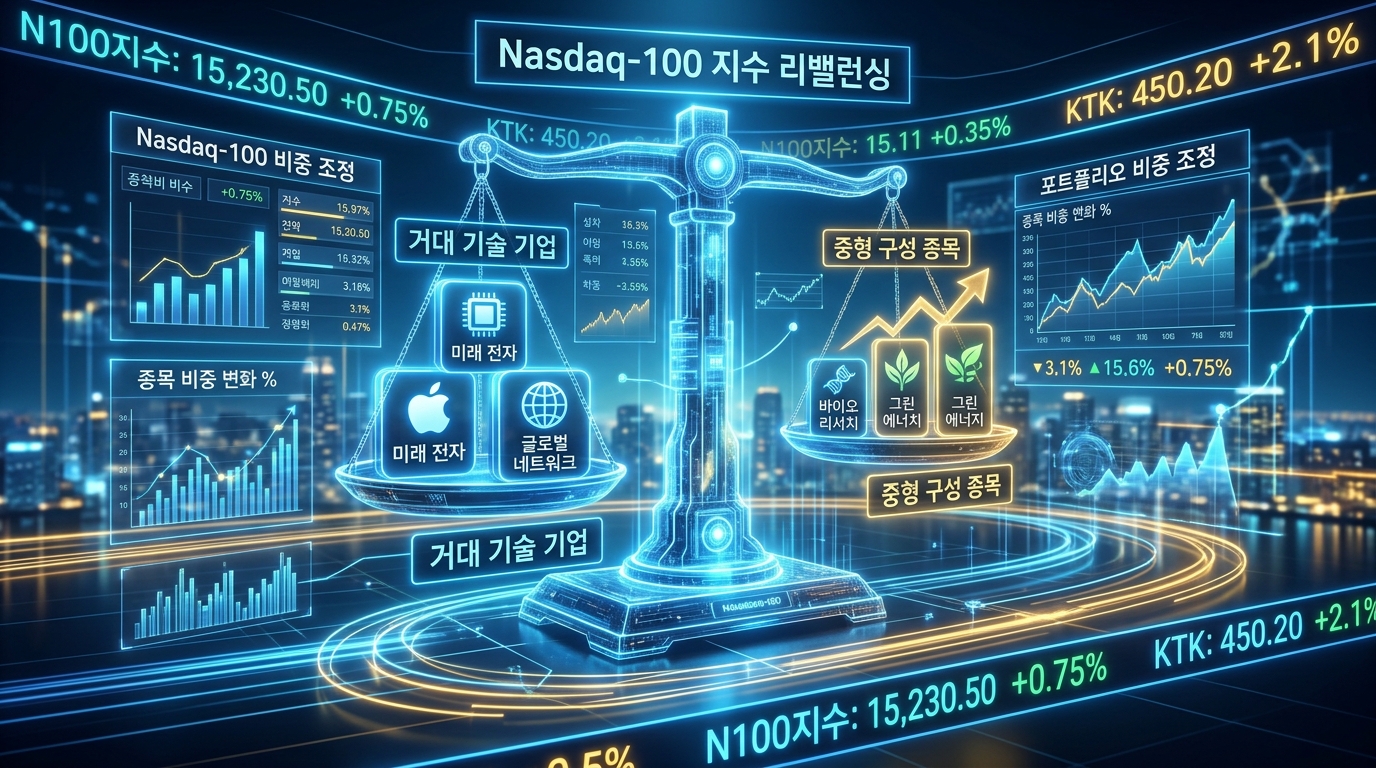
We take a precise look at the structural changes and capital flows within the Nasdaq-100 Index, which serves as a compass for the global tech sector.
Key Summary
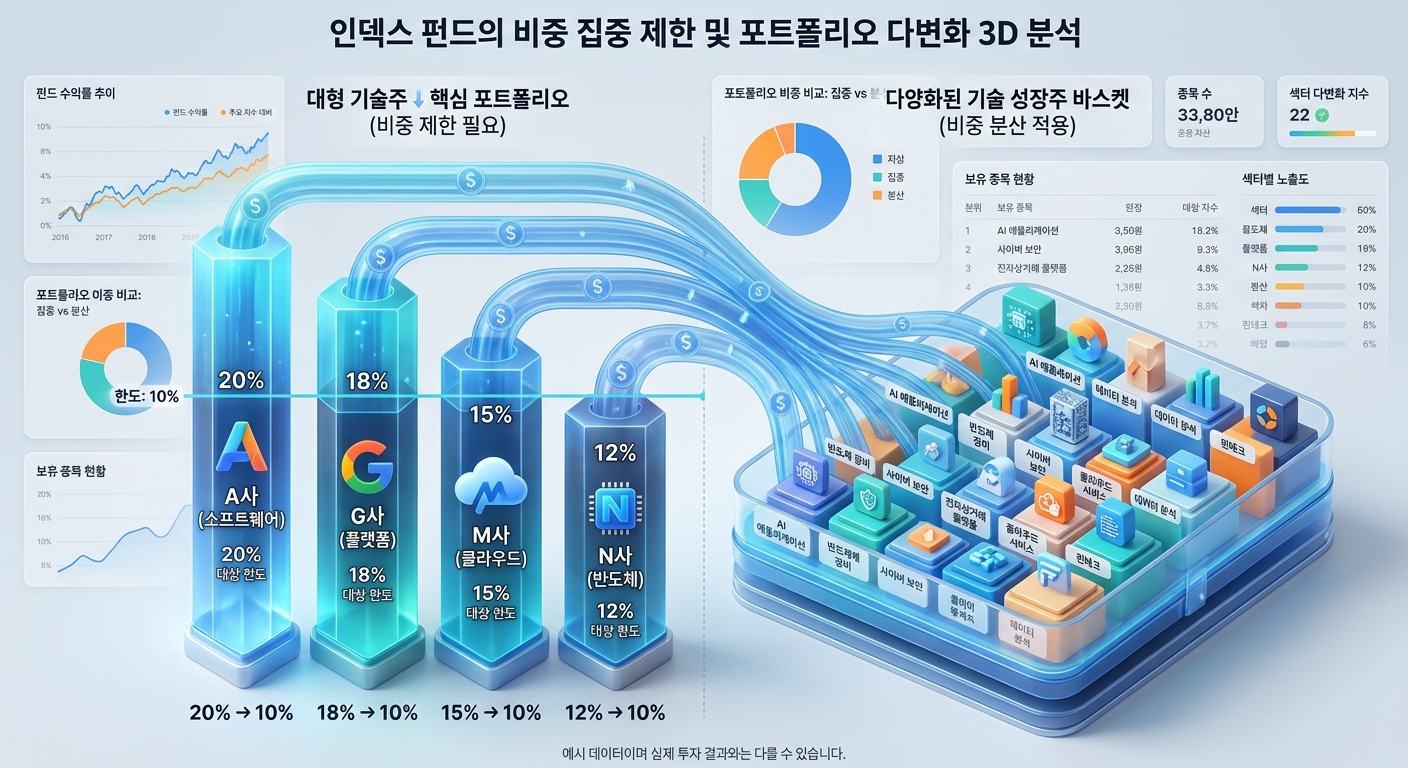
While the Nasdaq-100 Index fundamentally adopts a market-capitalization-weighted methodology, it applies a modified market-cap approach that artificially trims weights when specific conditions are met to prevent excessive concentration in a handful of mega-caps.
If the aggregate weight of companies exceeding a 4.5% individual weighting tops 48%, a special rebalancing mechanism is triggered to forcibly lower their combined weight to around 40%.
With Big Tech companies accelerating AI infrastructure investments and seeing differentiated stock performance, index concentration risk is once again coming to the forefront.
Mechanical selling by passive tracking funds and the subsequent reallocation of capital into non-Big Tech constituents could directly impact market supply-demand dynamics and individual stock multiples.
Current Market Snapshot
As of October 24, 2026, global financial markets are navigating a phase where macroeconomic uncertainty coexists with earnings sensitivity.
The Nasdaq Index stands at 25,955.34, while the USD/KRW exchange rate closed at 1,326.00 KRW.
In the South Korean domestic market, the KOSPI recorded 5,550.30 and the KOSDAQ settled at 751.69.
Looking at sentiment indicators, the Daily Stock Fear & Greed Index places the Nasdaq currently in the "Fear" (21) zone.
Compared to "Fear" (22.1) a week ago, "Fear" (32.5) a month ago, and "Fear" (27.6) three months ago, investor sentiment remains depressed.
Meanwhile, the KOSPI is in "Extreme Fear" (7.1), reflecting severe risk-off sentiment compared to 6.6 a week ago, 52 a month ago, and 13.5 three months ago.
| Category | Key Criteria & Mechanism | Market & Capital Flow Impact |
|---|---|---|
| **Regular Rebalancing** | Quarterly weight reviews and annual reconstitution every December | Reflects changes in free float and market capitalization |
| **Capping Rule (Stage 1)** | When an individual stock's weight exceeds 24%, it is capped at a maximum of 20% | Prevents excessive index distortion from a single constituent |
| **Overcrowding Relief (Stage 2)** | When the aggregate weight of companies exceeding 4.5% tops 48%, it is reduced to 40% | Enforces mandatory weight reductions on the top 5–7 mega-caps |
| **Supply/Demand Transmission** | Simultaneous program execution by passive ETFs such as QQQ | Selling pressure on Big Tech paired with buying inflows into lower-ranked constituents |
Financial Analysis
The combined capital expenditure (CAPEX) of the top seven companies (M7) in the Nasdaq-100 reaches hundreds of billions of dollars annually, accounting for more than 60% of total index CAPEX.
Large-scale spending concentrated on AI computing infrastructure and data center expansion increases depreciation burdens while heightening the volatility of free cash flow (FCF) margins.
In contrast, the roughly 90 other constituents outside the top Big Tech cohort maintain relatively disciplined capital spending, focusing on cost controls.
As a result, Big Tech may experience decelerating profit growth momentum relative to their strong top-line revenue growth, whereas lower-tier constituents may demonstrate differentiated resilience in cash flow stability.
Valuation
The 12-month forward price-to-earnings (P/E) ratio of the Nasdaq-100 trades around 27x to 29x, maintaining a distinct premium over the S&P 500's roughly 21x to 22x.
As the 10-year US Treasury yield (US10Y) fluctuates, high-multiple tech equities continue to face ongoing sensitivity to elevated discount rates.
Relative strength in the US Dollar Index (DXY) and intermittent spikes in the Volatility Index (VIX) create a macroeconomic environment that caps further P/E multiple expansion.
Compared to the Philadelphia Semiconductor Index (SOX), which displays high beta tied to hardware cycles, the Nasdaq-100 exhibits more nuanced interest rate sensitivity due to its significant platform and software weighting.
Expert & Institutional Analysis
Major Wall Street investment banks view Nasdaq-100 weight capping rules as an institutional safeguard against fundamental distortions in passive funds.
The prevailing view is that short-term volatility could pick up as multi-trillion-dollar benchmark-tracking funds are forced to execute simultaneous sales of the top mega-cap stocks.
Conversely, high-quality software, biotech, and industrial technology names ranked outside the top 10 stand to benefit from a welcome inflow of redistributed passive capital.
Some institutional investors also interpret this as a turning point where the relative appeal of equal-weight portfolios or smart-beta strategies seeking index-beating alpha becomes more prominent.
Risk Factors
The foremost downside risk is a scenario where the aggressive AI CAPEX deployed by Big Tech fails to convert into monetization at the pace expected by the market.
If monetization milestones are delayed, massive CAPEX could rapidly turn into margin compression, triggering sudden valuation multiple contractions.
Additionally, antitrust lawsuits and structural breakup pressures from global regulatory authorities—including the US Department of Justice (DOJ) and Federal Trade Commission (FTC)—remain lingering overhangs.
Should the Federal Reserve's rate-cut path stall due to sticky inflation, the risk of broad valuation resets driven by a spike in the US10Y yield cannot be ruled out.
Investment Perspective
A Nasdaq-100 rebalancing should be viewed as an institutional supply-and-demand event rather than an impairment of individual corporate fundamentals.
Big Tech stocks may experience short-term price consolidations as they absorb mechanical selling pressure from passive funds.
Conversely, solid growth companies ranked between 10th and 50th that receive upward weight revisions are likely to see downside support backed by institutional capital inflows.
During this transitional phase of easing index concentration, strategies that balance portfolio diversification with close monitoring of bond yields appear more suitable than heavy single-stock concentration.
Daily Stock Q&A
Q1. What are the exact conditions that trigger a Nasdaq-100 Special Rebalancing?
A special rebalancing is triggered when the aggregate weight of companies whose individual weights exceed 4.5% tops 48% of the index.
Once met, the combined weight of these top-tier companies is collectively trimmed back to around 40%.
Q2. What is the difference between regular and special rebalancing?
Regular rebalancing is scheduled and executed routinely through quarterly weight reviews (March, June, September, December) and an annual reconstitution in December.
In contrast, a special rebalancing is an ad-hoc intervention executed when extreme concentration creates risks of funds breaching regulatory diversification thresholds.
Q3. How do major ETFs like QQQ respond when rebalancing occurs?
Index funds and ETFs tracking the Nasdaq-100 sell trimmed constituents and simultaneously buy augmented constituents to match the effective implementation date.
This process involves large-scale closing auction program trades, resulting in a temporary surge in trading volumes.
Q4. Does a reduced Big Tech weighting dampen the expected returns of the Nasdaq-100?
Even if top-stock weightings decline, long-term returns are not inherently compromised as long as core earnings growth remains intact.
Historical precedents show that while short-term volatility occurred immediately around rebalancings, medium-to-long-term direction ultimately converged with macro rate trends and underlying fundamentals.
Q5. Which key metrics should investors watch during a rebalancing phase?
Investors should keep a close eye on fluctuations in the 10-year US Treasury yield (US10Y) alongside quarterly trends in Big Tech CAPEX-to-revenue growth.
Additionally, monitoring broad market risk appetite through the VIX Index and stabilization levels in the US Dollar Index (DXY) is recommended.