
Hello, this is Daily Stock, tracking the pulse of global tech and financial markets.
Key Takeaways
NVIDIA's next-generation AI computing platform, the Blackwell architecture, is officially entering the phase of high-volume mass production and hyperscaler deliveries.
Despite initial yield challenges and rising cost pressures associated with complex server rack-level packaging and liquid cooling infrastructure, the market's primary evaluation metric is whether Data Center gross margin can hold in the mid-70s range.
As of intraday trading in Korea on October 23, 2026 (provisional), the global market environment is displaying caution amid macroeconomic volatility and valuation burdens.
While NVIDIA's intraday price remains 'unconfirmed for the day (based on latest verified data)', the scale of global Big Tech capital expenditures (CAPEX) and the trajectory of the US 10-year Treasury yield are poised to be key inflection points for future valuation multiples.
Current Market Overview
Global asset markets remain in a delicate phase where safe-haven preferences coexist with caution toward risk assets.
As of today's intraday trading (provisional), the KOSPI stands at 5,533.77, the KOSDAQ at 764.10, and the USD/KRW exchange rate is trading at 1,327.00 KRW.
The Nasdaq Composite, the barometer for tech equities on Wall Street, is at 26,008.86 points, exhibiting a wait-and-see posture ahead of major Big Tech earnings releases.
Regardless of index-level support, overall investor sentiment remains subdued.
According to the proprietary Daily Stock Fear & Greed Index (0–100), the KOSPI Fear & Greed Index currently registers 'Extreme Fear' at 7.1.
While this represents a slight rebound from 'Extreme Fear' (6.6) one week ago, it highlights depressed sentiment compared to 'Neutral' (48.2) one month ago and 'Extreme Fear' (12.8) three months ago.
The Nasdaq Fear & Greed Index also stands in 'Extreme Fear' at 19.8, signaling significant risk aversion.
Compared to 'Fear' one week ago (30.3), one month ago (35.0), and three months ago (26.4), this metric reflects expanding volatility and ongoing compression on tech valuation multiples.
Across the broader market, the relative strength of the Philadelphia Semiconductor Index (SOX) and the Nasdaq 100 is being tested.
The relative firmness of the US Dollar Index (DXY) and periodic spikes in the Volatility Index (VIX) continue to drive position trimming across risk assets.
Financial Analysis
NVIDIA's primary growth engine, the Data Center business unit, is transitioning product generations from Hopper-based H100 and H200 chips to Blackwell B200 and GB200 NVL72 systems.
As customer demand for large language model (LLM) inference and training accelerates, the revenue share of end-to-end solutions—including networking hardware such as Quantum InfiniBand and Spectrum-X—continues to expand.
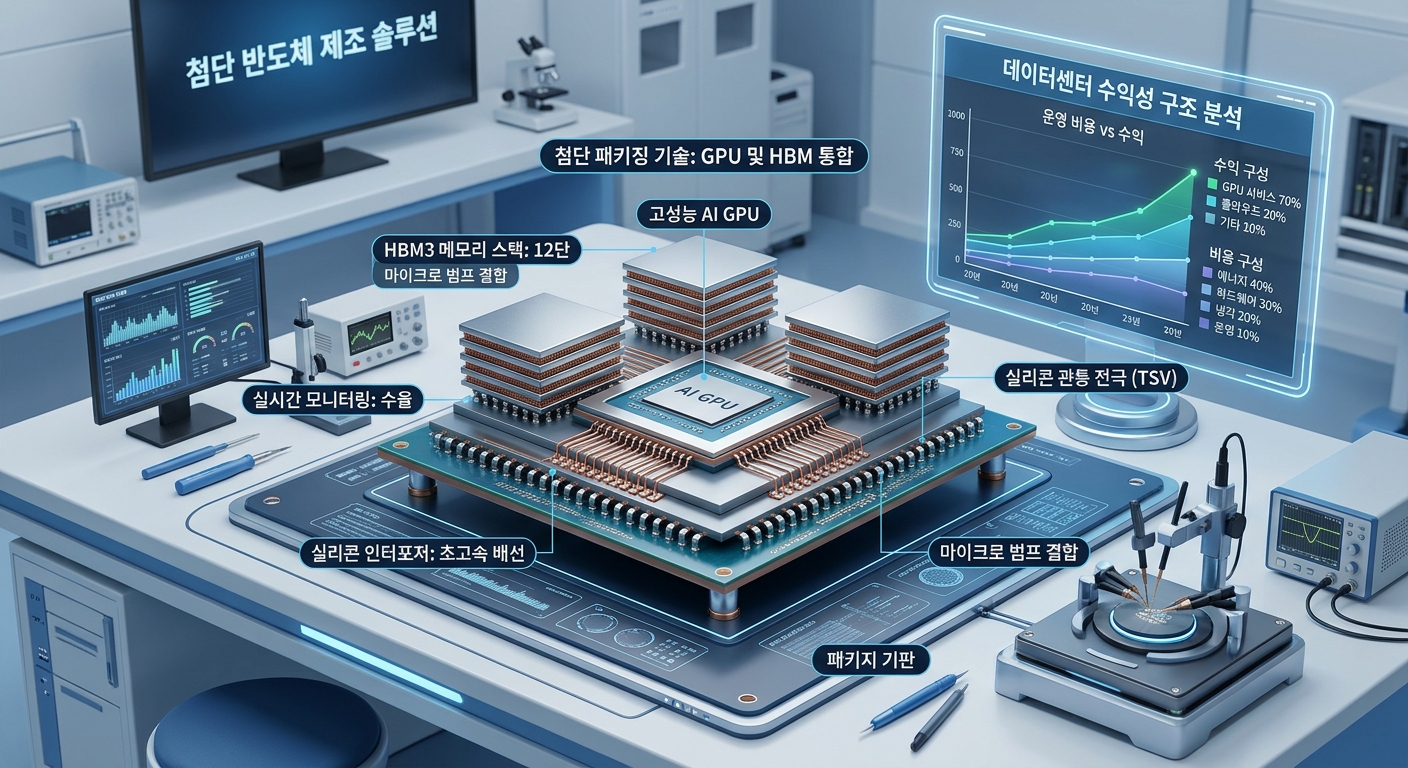
During the initial rollout of Blackwell systems, normalizing advanced packaging (CoWoS-L) yields at TSMC and higher unit costs for liquid cooling components created cost headwinds.
Consequently, whether Non-GAAP gross margins—which experienced temporary pressure down toward the low-70s range in the prior quarter—can maintain levels around 74–75% through mass production scale and die-level yield improvements represents a critical variable for upcoming earnings.
| Category | Hopper-Centric Phase (Past Transition) | Blackwell Ramp Phase (Current Stage) | Projected Rubin Entry Scenario |
|---|---|---|---|
| **Core Platform** | H100, H200 HGX | B200, GB200 NVL72 | R100, GR200 NVL Systems |
| **Company Gross Margin** | Around 75% (Stable High Margins) | 73–75% (Initial Ramp Cost Dilution) | Return toward 75% or Moderate Stabilization |
| **Networking Link Share** | Predominantly InfiniBand | Rapid Rise in Spectrum-X Ethernet | Integrated Next-Gen Ultra-Bandwidth Fabric |
| **Key Cost Variables** | HBM3E Supply, Packaging Bottlenecks | CoWoS-L Complexity, Liquid Cooling | HBM4 Integration & Node Shrink Costs |
Because hyperscalers' annual CAPEX plans remain firm, revenue downside appears well protected.
However, on the cost side, the dilutive impact of high-bandwidth memory (HBM) procurement pricing and server rack-level assembly fees on consolidated margins warrants continued monitoring.
Valuation
NVIDIA's valuation multiples have reflected a premium not merely as a semiconductor manufacturer, but as a dominant platform for AI-accelerated computing infrastructure encompassing both hardware and the CUDA software ecosystem.
However, fluctuations in the US 10-year Treasury yield (US10Y) and subsequent changes in discount rates have left price-to-earnings (P/E) multiples across high-valuation growth stocks sensitive to rate moves.
Currently, NVIDIA's forward P/E sits near the midpoint of its historical three-year band, easing from prior extremes.
The premium assigned over S&P 500 large-cap growth stocks and the Nasdaq 100 can be justified by actual delivery speeds of Blackwell shipment volumes and visibility into its next-generation chip roadmap.
If Data Center gross margins become entrenched in the low-70s, markets could adjust target multiples downward over concerns of decelerating earnings growth.
Conversely, if margin resilience around 75% is confirmed through yield improvements, strong return on equity (ROE) and robust free cash flow (FCF) generation can serve as valuation support.
Institutional and Expert Perspectives
Major Wall Street investment banks project that NVIDIA's dominant market share will persist as Blackwell supply bottlenecks ease.
Firms such as Goldman Sachs and Morgan Stanley note that as long as AI capital spending across the four leading hyperscalers (Microsoft, Meta, Google, and Amazon) remains intact, quarterly revenue scale can continue reaching record highs.

However, institutions including Bank of America (BofA) are focusing on the duration of margin pressures experienced during product transitions.
Shifting from discrete chip sales to large rack-scale system deliveries dramatically expands top-line revenue but introduces a mix effect that can slightly compress gross margins.
Additionally, some market watchers highlight that the progress of custom ASIC accelerator developers within the broader semiconductor ecosystem could gradually challenge NVIDIA's long-term pricing power.
Institutions view commentary regarding supply chain lead-time reductions and the adoption pace of liquid-cooled racks as primary focus points for upcoming quarterly conference calls.
Risk Factors
The most fundamental risk is potential delays in the monetization of end-user AI services.
Even with hyperscalers maintaining substantial capital expenditures, if revenue realization from generative AI applications lags expectations, a moderation in CAPEX growth could emerge beyond 2027.
A second risk stems from macroeconomic variables, specifically Federal Reserve interest rate uncertainty and elevated 10-year US Treasury yields.
The Nasdaq Fear & Greed Index remaining in 'Extreme Fear' (19.8) reflects these discount rate concerns and broader profit-taking pressures on growth equities.
A third factor involves tightening semiconductor export controls to China and the evolving geopolitical regulatory landscape.
Should restrictions on China-specific chips escalate further or global supply chain fragmentation intensify, reductions in addressable demand and associated inventory valuation pressures could follow.
Investment Perspective Summary
At this juncture, approaching NVIDIA through phased assessments of earnings quality rather than chasing short-term momentum appears prudent.
While large-scale shipments of Blackwell chips support top-line revenue expansion, sustainable upside momentum requires proof of earnings quality via gross margin defense.
With Fear & Greed indices in both domestic and international markets residing in extreme fear territory, broader market expectations have moderated.
Accordingly, tracking whether gross margin guidance indicates a clear path back toward the mid-70% range alongside hyperscaler order backlog stability offers a structured, scenario-based approach.
Q&A with Daily Stock
Q1. Why do Data Center gross margins temporarily face downward pressure as Blackwell shipments ramp?
In the early stages of a new architecture rollout, costs compound from manufacturing complexity, yield stabilization for TSMC advanced packaging (CoWoS-L), and sourcing specialized liquid-cooled rack components. As shipment mix shifts from discrete chips to complex server racks (such as the GB200 NVL72), a higher proportion of hardware bill-of-materials (BOM) costs creates a dilutive effect on overall gross margins.
Q2. What are management's medium-to-long-term gross margin expectations?
NVIDIA management has historically guided that after temporary margin adjustments during the initial Blackwell ramp phase, gross margins are expected to return toward the mid-70s range as yields optimize and supply chain efficiencies take hold.
Q3. What does the Nasdaq Fear & Greed Index at 'Extreme Fear' (19.8) indicate?
Regardless of absolute index levels, this reading shows that market sentiment is heavily depressed due to volatility metrics, tech-stock positioning momentum, and elevated downside hedging demand in options markets. Because near-term volatility may persist, caution is warranted regarding aggressive momentum-buying ahead of major earnings and macro data releases.
Q4. Does the development of custom chips (ASICs) by Big Tech pose an immediate threat to NVIDIA?
In the near term, custom ASICs are unlikely to fully displace NVIDIA's high-performance general-purpose GPUs and deeply entrenched CUDA software ecosystem. However, as the proportion of ASICs grows for specific workloads—such as model inference—NVIDIA's long-term pricing power premium could face gradual limitations.
Q5. How do fluctuations in the US 10-year Treasury yield impact NVIDIA's stock performance?
Long-term yields act as the discount rate when valuing the future cash flows of high-growth tech companies. When the 10-year yield rises, growth multiples face compression, driving higher share price volatility. Conversely, when yields stabilize, underlying earnings growth tends to be reflected more favorably in equity valuations.