Hello, this is Daily Stock, delivering precise insights into market trends and the fundamentals of key companies.
Executive Summary
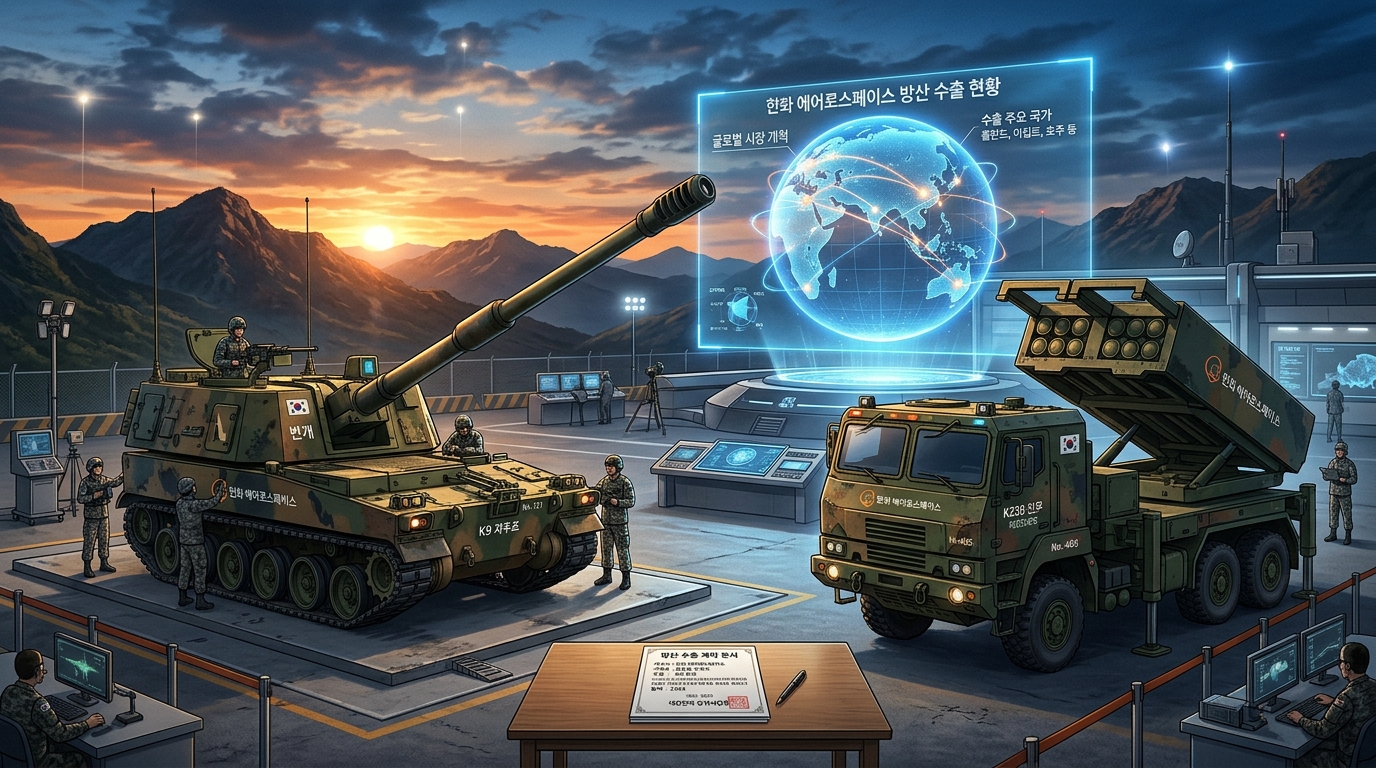
Hanwha Aerospace has entered full-scale production and sequential delivery stages for the second executive contracts covering the Polish K9 self-propelled howitzer and Chunmoo multiple launch rocket system (MLRS).
Q3 2026 earnings may temporarily miss market consensus due to revenue recognition deferrals caused by final inspection and shipping schedules for some Romanian and Polish deliveries, coupled with foreign exchange fluctuations in the KRW/USD pair.
However, this is merely a difference in the timing of deliveries rather than a structural slowdown in demand or production disruptions. The outlook remains solid, backed by a strong earnings rebound anticipated from concentrated deliveries in Q4 and the potential signing of the third K9 executive contract (EC3) within the year.
Current Market Context
On October 22, 2026, the domestic stock market closed with the KOSPI at 5,533.77 and the KOSDAQ at 764.10.
According to Daily Stock's proprietary Fear & Greed Index, the KOSPI is currently in the "Extreme Fear (8.9)" stage, slightly up from a week ago (4.9) but still reflecting severely subdued sentiment. The Nasdaq Fear & Greed Index also remains in the "Fear (31.3)" zone.
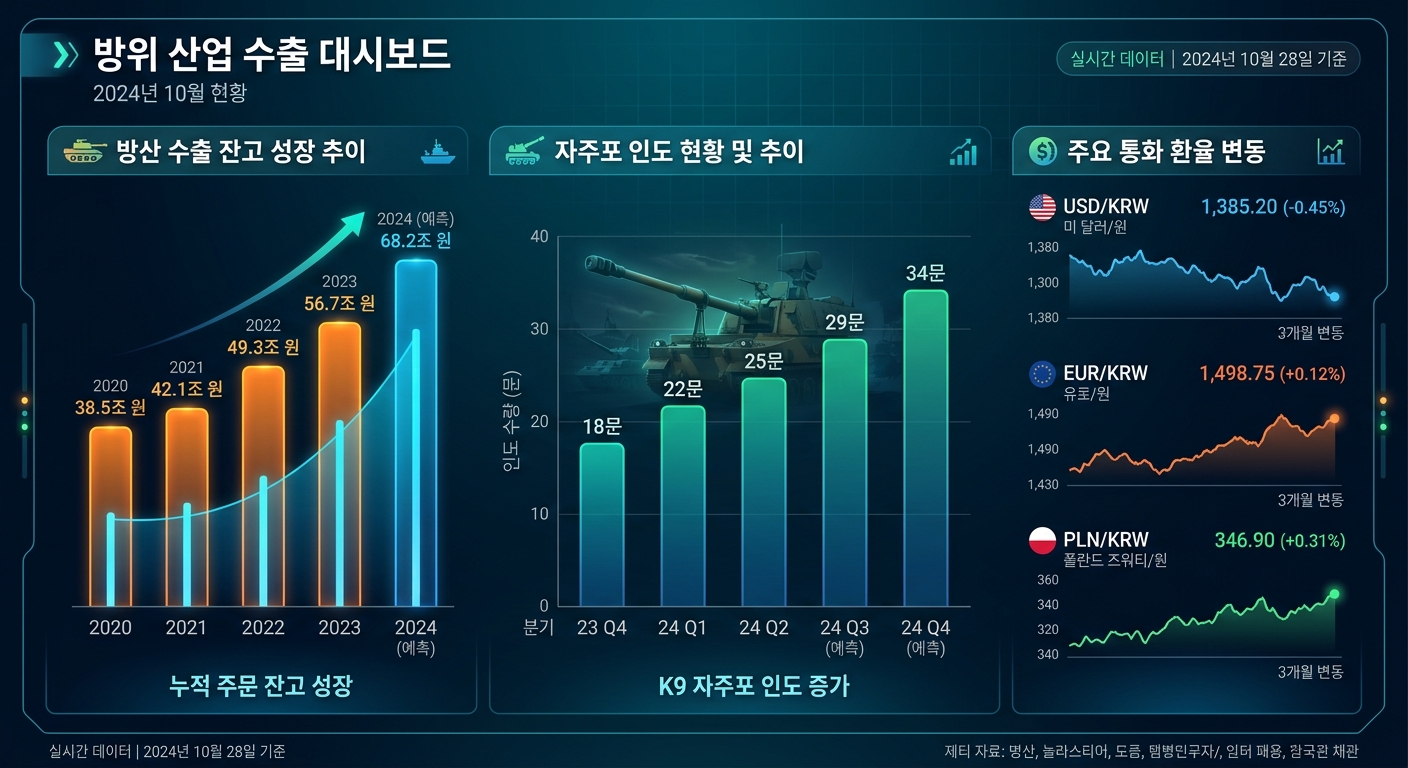
The USD/KRW exchange rate stands at 1,323.20 KRW. As currency volatility has picked up relative to the first half, the extent of FX gains among major exporters is differentiating across quarters.
Hanwha Aerospace's daily close is marked as "Unconfirmed for the day (based on latest available data)," but short-term earnings expectations are undergoing downward adjustments ahead of Q3 results amid an ongoing sector-wide order boom.
On the order front, follow-up production for Poland's second executive contract for the K9 (152 units, approx. 3.4475 trillion KRW) signed at the end of 2023, and the second Chunmoo contract (72 units, approx. 2.2526 trillion KRW), is progressing steadily.
Financial Analysis
Hanwha Aerospace's consolidated Q3 performance is estimated at 7.15 trillion to 7.63 trillion KRW in revenue and 980 billion to 1.10 trillion KRW in operating profit, making it likely to fall somewhat short of previous market consensus (operating profit around the 1.2 trillion KRW level).
This temporary dip in operating profit expectations is largely attributable to the shift in final revenue recognition into Q4, driven by performance verifications and schedule realignments for initial Polish K9 units and Romanian K9 howitzers (including 7 initial units).
| Metric | Q3 2025 (Actual) | Q3 2026 (Estimate) | Q4 2026 (Forecast) | Key Drivers & Characteristics |
|---|---|---|---|---|
| **Consolidated Revenue** | Approx. 6.48T KRW | Approx. 7.15T–7.36T KRW | Approx. 9.50T–10.50T KRW | Concentrated recognition of deferred Q3 volumes in Q4 |
| **Consolidated Operating Profit** | Approx. 839.0B KRW | Approx. 980.0B–1.10T KRW | Approx. 1.40T–1.46T KRW | Demonstrating robust baseline quarterly profitability |
| **Defense Order Backlog** | Low 50T KRW range | Over 60.92T KRW | Potential to top 65T KRW | Includes remaining Poland contracts, Romania, Australia |
| **Major Export Contributors** | Poland K9 1st contract delivery | Mainly Chunmoo deliveries (partial K9 deferrals) | Concentrated large-scale Poland K9 deliveries | Variations in quarterly revenue mix |
While quarterly volatility persists in the land systems division based on delivery timing schedules, foundational earnings capacity remains intact, further supported by operational improvements at consolidated subsidiaries Hanwha Systems and Hanwha Ocean.
In particular, if deferred Q3 deliveries are recognized in bulk in Q4, operating profit for the fourth quarter could surpass 1.4 trillion KRW, potentially setting another all-time quarterly record.
Valuation
Hanwha Aerospace commands an unparalleled order backlog in the global land defense systems sector, underpinned by strong price competitiveness and rapid delivery capability.
While global peers such as Germany's Rheinmetall and the US's General Dynamics trade at 12-month forward P/E multiples of 20x to 25x, Hanwha Aerospace trades at roughly 14x to 16x on mid-to-long-term forward P/E, maintaining solid valuation appeal.
However, net foreign selling across large-cap KOSPI names and dampened market sentiment in Korea continue to act as overhangs, constraining multiple expansion for the company.
Consequently, the triggers for a valuation rerating go beyond verifying headline Q3 figures—they will depend on the finalization of the Polish K9 EC3 contract and the pace of conversion across pipelines in Western Europe and the Middle East.
Expert and Institutional Analysis
Domestic brokerage firms have maintained their unanimous "Buy" ratings even while slightly trimming target prices in their recent Q3 previews.
Firms such as Daishin Securities and DS Investment & Securities emphasize that the current quarterly deceleration reflects simple delivery timeline shifts rather than contract cancellations or order losses.
Analysts highlight that the revenue gap resulting from delayed acceptance testing for the initial 7 K9 units for Romania and certain Polish volumes will convert directly into earnings in Q4.
Furthermore, they point to a strong pipeline of international catalysts heading into year-end and next year—including Middle East integrated packages (UAE, Saudi Arabia) and the US Army's self-propelled howitzer modernization review—as clear structural positives.
Risk Factors
The most immediate risk is the short-term decline and increased volatility of the USD/KRW exchange rate.
With the exchange rate falling toward the 1,323.20 KRW level, the export margin premium enjoyed during the high-exchange-rate environment may see some compression.
A second consideration involves execution risks tied to localization mandates and technology transfers.
In Poland's second and prospective third contracts, local assembly production and integrated supply chains have become core requirements beyond simple finished-vehicle direct exports, meaning delays in setting up manufacturing lines could lead to delivery schedule risks.
Finally, the potential for timing gaps in global defense budget execution and shifting geopolitical policy environments cannot be ruled out.
Investment Perspective
When evaluating Hanwha Aerospace, the core focus should remain on the qualitative growth of its order backlog and its delivery turnover rate, rather than quarterly volatility.
The potential Q3 earnings miss is already in the process of being priced in by the market. The underlying intrinsic value lies in the cash conversion cycle of its massive backlog exceeding 60 trillion KRW.
Amid Bank of Korea monetary policy directions and broader currency trends, an effective strategy will involve monitoring supply-demand flows around large-cap exporters and verifying whether the scenario of concentrated fourth-quarter deliveries unfolds as expected.
Investor Checklist Q&A
Q1. What is the primary reason Q3 earnings are expected to fall short of market consensus?
A. Revenue recognition was deferred to Q4 as local handover procedures and inspection timelines for initial K9 shipments bound for Poland and Romania were pushed back, compounded by the pullback in the USD/KRW exchange rate.
Q2. Does this earnings deferral negatively impact contract execution or full-year earnings?
A. Because this does not stem from production line defects or contract defaults, the earnings have not vanished. The deferred shipments are expected to be recognized in Q4, meaning the likelihood of damage to full-year aggregate earnings remains low.
Q3. What is the status of the second Polish executive contract, and what are the prospects for the third contract (EC3)?
A. Production for the second executive contract—covering 152 K9 units and 72 Chunmoo systems—is running smoothly on schedule. Negotiations between military authorities from both nations regarding the subsequent K9 EC3 contract targeting late 2026 or early next year are currently underway.
Q4. How broadly can the defense order pipeline expand beyond Eastern Europe?
A. Serial production is underway for Australia's Redback IFV and AS9 Huntsman, as well as Egypt's K9 program. Meanwhile, multi-tier defense package bids across Saudi Arabia and the UAE, alongside the US Army's howitzer modernization review, represent active pipeline opportunities.
Q5. What effect does foreign exchange fluctuation (USD/KRW at 1,323.20) have on export margins?
A. While a lower exchange rate could slightly compress KRW-denominated land defense margins, base-rate hedging at contract signing and spread-out cost structures make the risk of sharp margin deterioration limited.