
Hello. This is DailyStock, objectively tracking financial performance and value chain data of global tech companies.
Key Takeaways
- Palantir is executing a dual-track growth strategy across public and commercial sectors, driven by long-term public sector contract backlogs and the accelerating adoption of its enterprise AI platform (AIP).
- As of intraday trading on 2026-10-22 (provisional), the Nasdaq Composite stands at 26,702.86, with DailyStock's proprietary Fear & Greed Index lingering in the "Fear" zone at 31.4.
- Integration with major defense procurement systems provides a robust floor for earnings, whereas elevated valuation multiples remain structurally vulnerable to volatility in the 10-year US Treasury yield.
- As enterprise adoption of generative AI transitions from proof-of-concept (PoC) stages to live production systems, qualitative growth in commercial total contract value (TCV) is becoming evident.
Market Context & Current Overview
As of intraday trading on 2026-10-22 (provisional), domestic and international markets continue to experience heightened volatility amid persistent concerns over prolonged high interest rates and geopolitical uncertainties.
In the South Korean market, the KOSPI is trading at 5,675.89, the KOSDAQ is at 788.67, and the USD/KRW exchange rate is hovering at 1,327.00 KRW.
According to the DailyStock Fear & Greed Index, which reflects market sentiment, the KOSPI is currently at 9.7, pointing to an "Extreme Fear" regime—following 4.9 (Extreme Fear) one week ago, 41.7 (Neutral) one month ago, and 17.3 (Extreme Fear) three months ago, highlighting sustained risk aversion.
US markets reflect a similarly cautious tone, with the Nasdaq Fear & Greed Index currently at 31.4 in the "Fear" category, compared to 26.7 (Fear) one week ago, 34.2 (Fear) one month ago, and 28.5 (Fear) three months ago.
Palantir (PLTR)'s intraday price remains "unconfirmed for the session (based on latest available quote)," yet positioned in the software execution tier relative to constituents of the Philadelphia Semiconductor Index (SOX) and the Nasdaq 100, the stock is testing differentiated relative momentum.
Amid expanding capital expenditures (CAPEX) from hyperscalers, market focus is gradually rotating from foundational infrastructure buildouts to application-layer software capable of generating real cash flows.
Financial Analysis
Palantir's top-line expansion stems from a complementary structural balance between US commercial operations and government procurement.
In particular, commercial clients onboarded through its AIP Bootcamps are shifting into enterprise-wide deployments, driving steep revenue growth in the US commercial segment.
| Metric | Details & Estimates | YoY & Highlights |
|---|---|---|
| **US Commercial Revenue** | Sustained steep quarterly growth (reaching the $764M level) | High triple-digit growth (+100%+) maintained |
| **Government Revenue** | Anchored by major defense programs like TITAN and Maven | Stable order visibility in the 20% to 40% range annually |
| **Operating Margin (Non-GAAP)** | Reaching upper-30% to mid-40% range | Margin expansion driven by fixed-cost operating leverage |
| **Free Cash Flow (FCF)** | Firmly positive on both quarterly and annual basis | Cash inflows accelerating via large-scale contract closures |
| **Rule of 40** | Combined growth rate and margin exceeding 90% to 120% | Significantly outperforming traditional SaaS benchmarks |
Large, multi-year government contracts provide a resilient revenue cushion, allowing the company to absorb surging enterprise demand in the commercial sector.
Coupled with disciplined operating expense controls and the scalability of its Ontology architecture, Palantir has consistently maintained positive GAAP net income.
Valuation
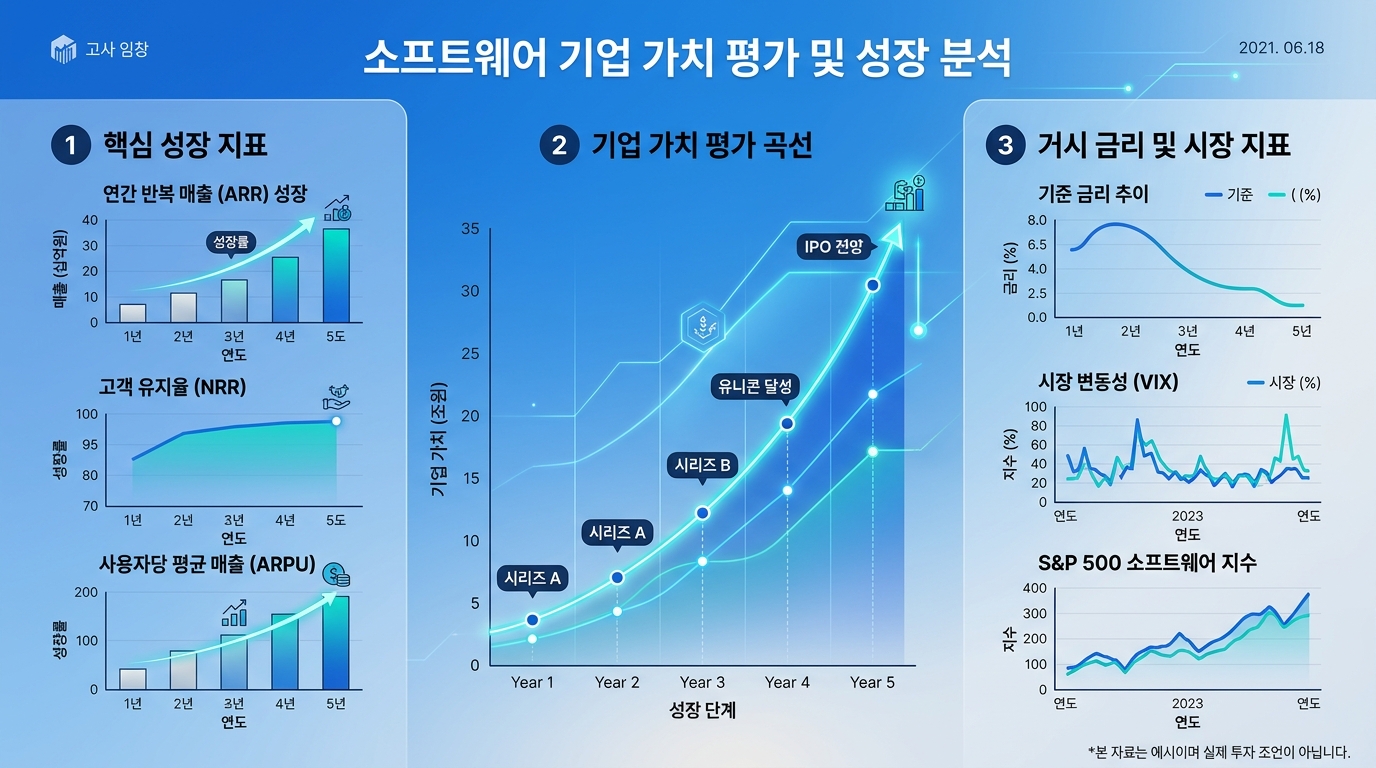
Palantir trades at a substantial premium across forward price-to-sales (Forward P/S) and forward price-to-earnings (Forward P/E) metrics compared to the broader enterprise software peer group.
These elevated multiples represent a primary vulnerability, exposing the stock to compression risks whenever the 10-year US Treasury yield (US10Y) and the US Dollar Index (DXY) trend upward.
Spikes in the Cboe Volatility Index (VIX) or a rebound in bond yields heighten the discount rate applied to future cash flows, presenting multiple-compression risks common to high-growth tech equities.
Consequently, justifying this valuation premium requires quarterly top-line expansion to consistently surpass market consensus estimates.
Compared to mega-cap growth stocks in the S&P 500 and leading big-tech firms in the Nasdaq 100, market observers frequently note that qualitative earnings acceleration is already heavily priced into the equity.
Expert & Institutional Analysis
Wall Street institutional sentiment remains split between optimism over Palantir's competitive moats and caution regarding its stretched valuation multiples.
Bullish analysts argue that Palantir's Ontology framework serves as an unmatched infrastructure layer that translates fragmented enterprise data into real-time operational decision models.
They emphasize its ability to seamlessly integrate foundational models with proprietary client data without the massive capital burden of developing proprietary large language models (LLMs).
Conversely, conservative institutions warn that the prevailing market price assumes flawless short-term execution ("priced for perfection").
These analysts caution that any macroeconomic slowdown that delays enterprise IT budgets or curtails contract expansion could trigger an inevitable downward valuation adjustment.
Risk Factors
The primary fundamental risk centers on potential delays in verifying tangible return on investment (ROI) from enterprise AI adoption.
If commercial prospects completing PoCs or Bootcamps fail to convert into enterprise-scale contracts, commercial revenue momentum could moderate.
A secondary risk involves political uncertainties in defense budget appropriations and procurement timelines.
Delays in budget approvals or strategic realignments within the US Department of Defense (DoD) and civil federal agencies could postpone the timing of backlog conversion into recognized revenue.
Lastly, monetary policy uncertainties driving rebounds in the 10-year Treasury yield alongside dollar strength remain persistent catalysts for elevated volatility in high-multiple tech equities.
Investment Perspective & Conclusion
Palantir possesses a rare business profile that blends the backlog stability of public defense contracts with high-velocity commercial growth.
However, with the Nasdaq Fear & Greed Index at 31.4 within the Fear zone, investors should factor in potential short-term price turbulence driven by macroeconomic crosscurrents.
From an execution perspective, aggressive investors should monitor net additions to US commercial customer accounts and remaining performance obligations (RPO) as core operational indicators.
Conservative investors may find it more prudent to scale in incrementally, waiting for bond yields to stabilize and valuation multiples to complete a period of consolidation.
A flexible allocation strategy that balances company-level fundamental expansion against prevailing macroeconomic headwinds remains the recommended approach.
FAQ
Q1. What differentiates Palantir's AIP from standard generative AI wrappers?
AIP does not simply route requests to LLM APIs; it operates atop an "Ontology" layer that maps an enterprise's data assets into actionable digital twins. This architecture preserves strict data security and governance, minimizes hallucination risks, and directly automates operational business processes.
Q2. How do Department of Defense (DoD) contracts support commercial expansion?
Proven deployment across highly classified, mission-critical defense environments validates software security and reliability, serving as a powerful credential when courting major corporate procurement teams. Furthermore, stable free cash flow generated by defense programs is reinvested into commercial Bootcamps and ongoing platform enhancements.
Q3. How significantly do fluctuations in the 10-year US Treasury yield (US10Y) affect the stock?
Because a significant portion of Palantir's valuation relies on cash flows projected further into the future, the stock is sensitive to changes in the discount rate. When Treasury yields climb, the present value of projected earnings declines, often leading to compression across valuation multiples like Price-to-Sales (P/S).
Q4. Why is commercial adoption in regions like Europe slower than in the US?
Strict European data sovereignty regulations and more conservative corporate decision-making have slowed cloud-based AI deployments relative to the US. In addition, whereas US enterprises leverage Bootcamps for rapid onboarding and deployment, European procurement cycles tend to be more protracted.
Q5. Is Palantir's high Rule of 40 score sustainable over the long term?
A combined revenue growth rate and operating margin near or exceeding 100% reflects the front-loaded impact of AIP conversions. As large enterprise deployments mature, natural growth deceleration may follow; sustained high levels will depend on client retention rates and expansion into supplementary software modules.