Hello, this is Daily Stock, delivering key insights into the global tech value chain and macroeconomic landscape.
Key Summary
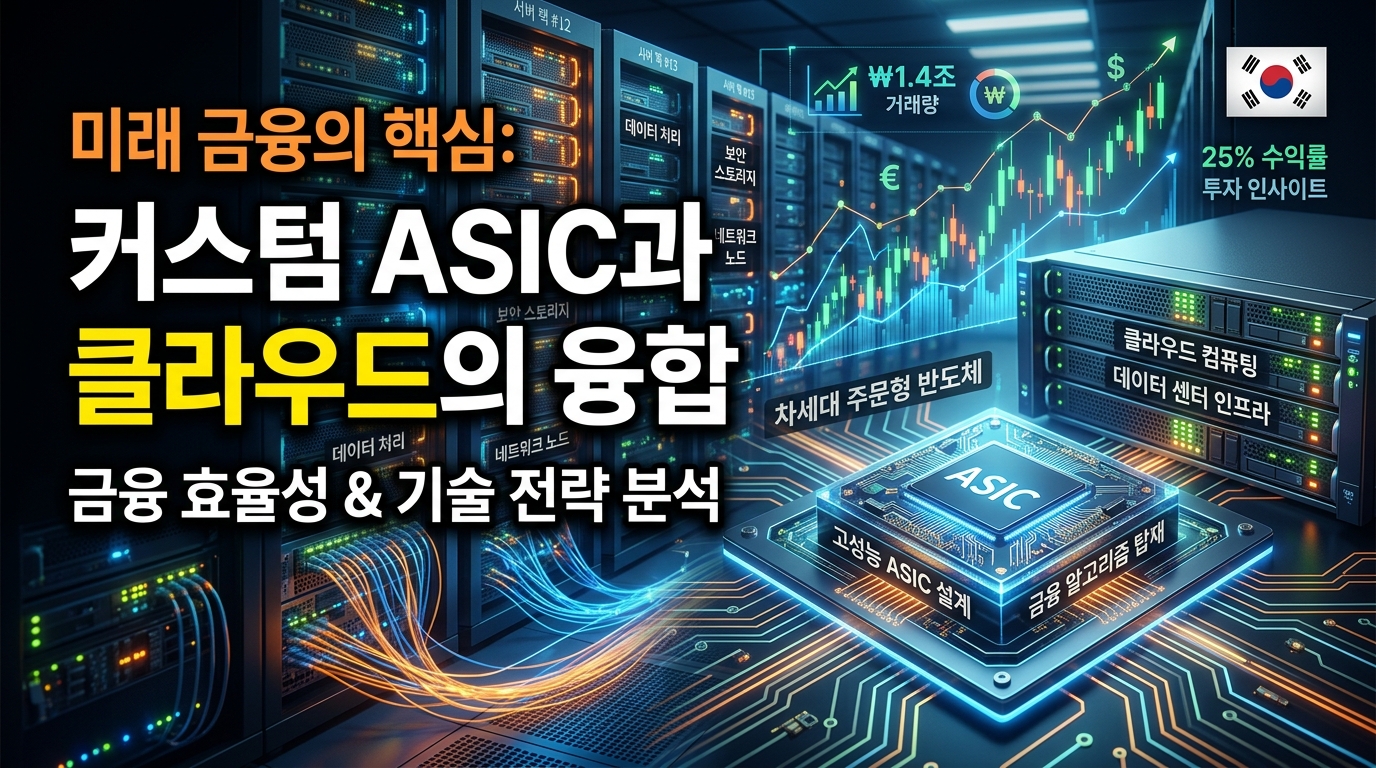
Broadcom (AVGO) has reorganized itself into a composite platform company that simultaneously captures Big Tech hyperscalers' demand to internalize proprietary AI accelerators (XPU/ASIC) and secures infrastructure software cash flow from VMware, an enterprise private cloud standard.
With the mass production of Google's TPU v8i and custom accelerator projects from major Big Tech firms—including OpenAI, Meta, and Anthropic—taking concrete shape, Broadcom's AI semiconductor backlog has surpassed $73 billion.
At the same time, massive free cash flow (FCF) generated by shifting VMware to a subscription model post-acquisition provides a buffer for upfront AI chip R&D investments, establishing a differentiated market position separate from NVIDIA's general-purpose GPU-centric landscape.
As of intraday trading on 2026-10-21 (tentative), while the Nasdaq Composite fluctuated around 26,424.82, the Daily Stock Nasdaq Fear & Greed Index stood at 27.2 (Fear), reflecting heightened multiple volatility across tech stocks.
Current Situation Overview
The global AI infrastructure market has entered an inflection point where hyperscalers are widely adopting custom ASICs to mitigate general-purpose GPU supply bottlenecks and high computing costs.
Broadcom continues to supply Google's next-generation TPU lineups while leading major custom chip designs, such as Meta's 2nd-generation MTIA and OpenAI's dedicated accelerator (Jalapeño), enjoying a near-monopoly status in the custom ASIC market.
Meanwhile, the macroeconomic environment applies strict performance verification criteria to high-P/E names within the Nasdaq 100 and the Philadelphia Semiconductor Index (SOX), driven by fluctuations in the 10-year US Treasury yield (US10Y) and sustained tension around the US Dollar Index (DXY).
Amid expanding Big Tech capital expenditures (CAPEX), Broadcom's share price (price unconfirmed on 2026-10-21; based on latest verified data) closely correlates with the pace at which its AI accelerator backlog converts into recognized revenue.
| Key Metric & Market Variable | Figure & Status (As of 2026-10-21 Intraday, Tentative) | Significance |
|---|---|---|
| Nasdaq Composite | 26,424.82 | Mixed trading trend centered on large-cap tech |
| KOSPI / KOSDAQ | 5,663.76 / 792.38 | Ongoing volatility phase in domestic equity markets |
| KRW/USD Exchange Rate | 1,324.50 KRW | Wait-and-see foreign exchange stance within a stable range |
| Daily Stock Nasdaq Fear & Greed | 27.2 (Fear) | Risk aversion expanded compared to Neutral (44.1) one week ago |
| Daily Stock KOSPI Fear & Greed | 6.7 (Extreme Fear) | Short-term liquidity contraction and bargain-hunting phase |
| Broadcom AI Backlog | Over $73 Billion | Combined total of custom ASICs and high-speed network switches |
Financial Analysis
Examining Broadcom's recent quarterly earnings trajectory, AI semiconductor revenue surged more than 200% year-over-year, leading the semiconductor solutions division.
In particular, shipments of hyperscaler-dedicated custom accelerators (XPUs) jumped more than 3.5 times year-over-year, establishing themselves as a core pillar accounting for approximately 73% of total AI semiconductor revenue.
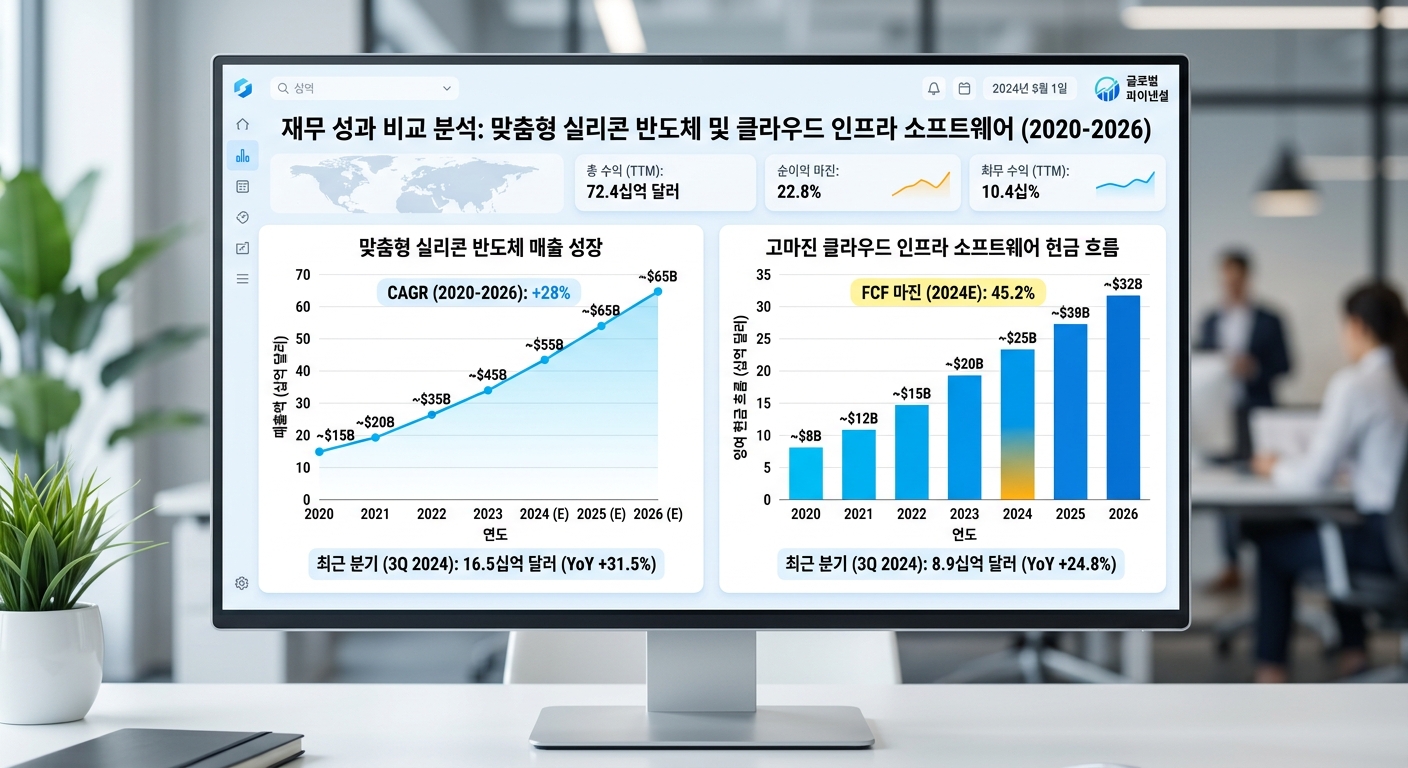
In the infrastructure software segment, transitioning VMware's licensing framework to an annual subscription model focused on 'VMware Cloud Foundation (VCF)' maximized revenue predictability and profitability.
With software gross margins exceeding 90% and operating margins hovering above 75%, Broadcom has established a virtuous cycle where internal free cash flow fully covers the working capital required for AI chip manufacturing.
However, as custom ASICs rapidly expand as a share of the business, investors should closely monitor how the hardware-integrated structure—which carries a relatively higher cost-of-goods-sold ratio compared to general-purpose merchant silicon—impacts overall corporate margins.
Valuation
Broadcom's price-to-earnings (P/E) multiple currently trades well above the historical 15–20x range seen during its days as a traditional communications semiconductor maker, commanding a premium in the mid-to-high 30s to 40x range similar to NVIDIA.
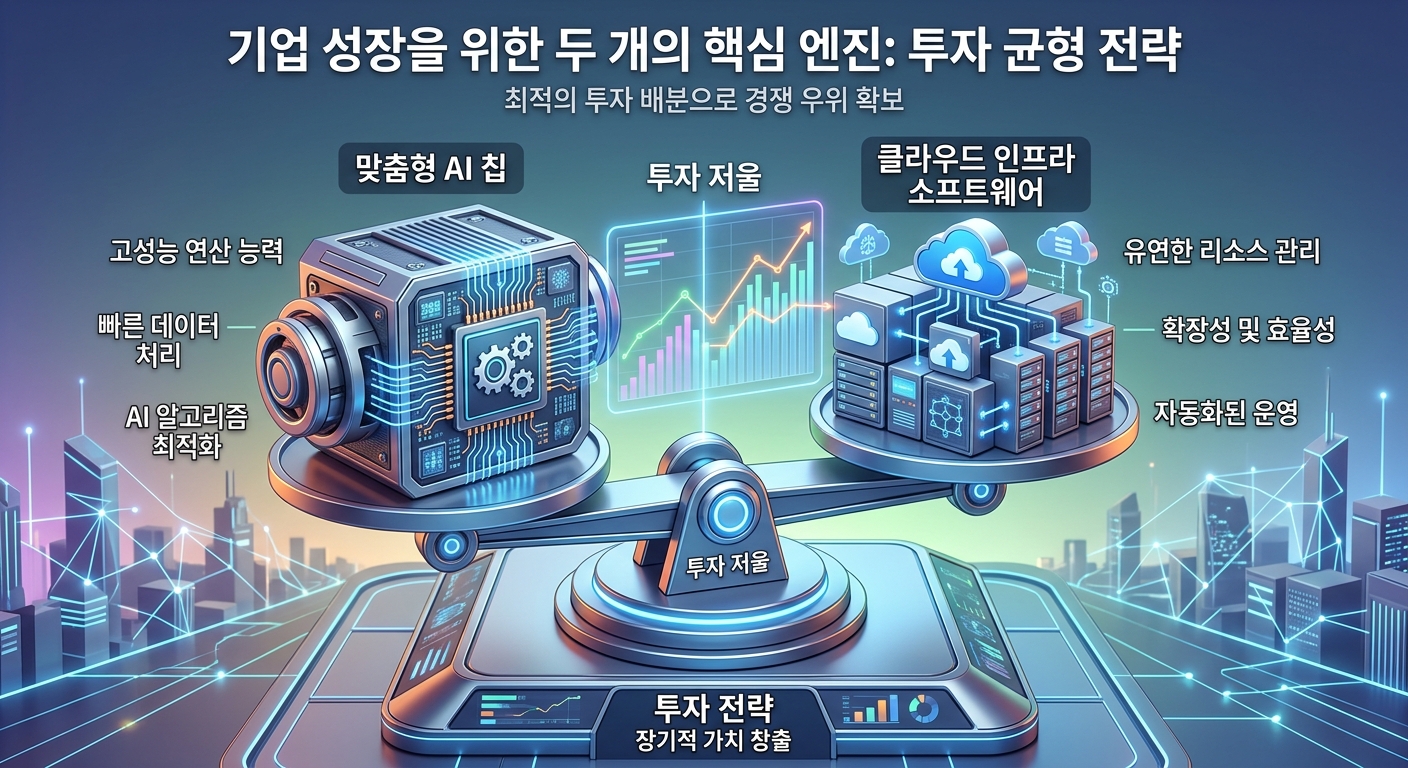
The market has re-rated Broadcom from a simple chip vendor into a 'two-engine' model: an 'AI infrastructure foundry architect' paired with a 'high-margin infrastructure software platform.'
However, if the 10-year US Treasury yield (US10Y) faces renewed upward pressure or the Volatility Index (VIX) spikes, valuation compression pressure on high-multiple tech names could inevitably spread.
For the Philadelphia Semiconductor Index to sustain its relative strength against S&P 500 growth stocks, Broadcom's projected roadmap to reach $100 billion in annual AI chip revenue by 2027 must be verified with hard numbers.
Ultimately, the current premium is premised on a scenario where hyperscalers avoid custom chip order cancellations while VMware's annual recurring revenue (ARR) provides a sturdy foundation.
Expert & Institutional Analysis
More than 90% of major Wall Street investment banks maintain a 'Buy' rating on Broadcom, presenting an average price target in the mid-$470 range.
Analysts at Mizuho and Morgan Stanley note that as TPU cluster buildout scale among key customers like Anthropic and Google expands into gigawatt (GW) units, Broadcom's mid- to long-term earnings visibility remains unmatched.
Furthermore, high-bandwidth Ethernet switch product lines—such as Tomahawk 6 and Jericho 3-AI—are viewed positively for capturing the open ecosystem against NVIDIA's proprietary InfiniBand network.
Conversely, some cautious market observers warn of potential customer churn among small and medium-sized enterprises due to VMware license price increases, as well as concentration risk tied to an AI backlog heavily weighted toward five major hyperscalers.
Institutions are treating upcoming Big Tech AI CAPEX guidance and earnings revisions as primary benchmarks for adjusting Broadcom portfolio weightings.
Risk Factors
The most fundamental risk is a potential slowdown in Big Tech CAPEX if the monetization of AI services is delayed.
If major cloud providers determine that the payback period for inference and training infrastructure is stretching out and consequently push back custom chip delivery schedules, execution of the $73 billion backlog could be delayed.
A second risk is customer concentration: top hyperscalers including Google, Meta, Anthropic, and OpenAI account for the majority of AI chip revenue, leaving Broadcom vulnerable to shifts in architectural roadmaps or complete internal design transitions by any single customer.
A third risk involves customer backlash and tightening regulatory scrutiny stemming from VMware's license policy changes.
If enterprise clients dissatisfied with the retirement of perpetual licenses and bundled sales shift toward open-source virtualization platforms (e.g., KVM, Nutanix), growth in this cash-cow engine could slow.
Lastly, from a macroeconomic perspective, rising US Treasury yields and liquidity contraction, paired with persistent US Dollar Index (DXY) strength, present ongoing downside multiple pressure across growth stocks.
Investment Perspective
Broadcom has solidified its position as the most realistic and powerful custom ASIC partner for Big Tech in an AI hardware landscape largely dominated by NVIDIA.
Its two-engine portfolio is operating smoothly: custom AI accelerators and high-speed Ethernet networking drive growth, while VMware supplies stable free cash flow.
However, as indicated by the Daily Stock Nasdaq Fear & Greed Index at 27.2 (Fear), short-term volatility warrants caution during periods when broader market risk appetite is subdued.
Therefore, during pullbacks where valuation burdens ease, a sensible strategy may be a phased, long-term accumulation approach while tracking hyperscalers' custom chip production schedules and VMware's VCF conversion rates.
Q&A with Daily Stock
Q1. Given the availability of NVIDIA's general-purpose GPUs, why are hyperscalers building custom ASICs with Broadcom?
Optimizing computing architecture specifically for dedicated AI services (search, ad recommendation, proprietary LLM inference, etc.) dramatically lowers power consumption and per-chip unit cost. Hyperscalers partner with Broadcom to reduce their reliance on expensive NVIDIA GPUs and lower total cost of ownership (TCO).
Q2. How reliable is Broadcom's $73 billion AI backlog figure?
This backlog is based on executed contracts for next-generation custom accelerator development and optical/Ethernet switch supply agreements with Google, Meta, Anthropic, OpenAI, and others. While scheduled for delivery over the next 18 to 24 months, quarterly revenue recognition timing remains subject to change depending on customers' data center completion schedules.
Q3. How does the VMware acquisition specifically support Broadcom's AI strategy?
VMware dominates private cloud infrastructure across Fortune 500 companies, consistently generating billions of dollars in annual cash flow. This high-margin subscription cash serves as a defensive financial cushion that funds large-scale AI semiconductor R&D and advanced packaging investments.
Q4. How should investors interpret the recent Nasdaq Fear & Greed Index reading of 27.2 (Fear) regarding AVGO?
It indicates that heightened market caution surrounding interest rate paths and elevated earnings expectations could trigger technical, liquidity-driven pullbacks unrelated to underlying fundamentals. This environment calls for phased positioning rather than aggressive chasing, while confirming AI revenue conversion rates and macro rate stabilization.
Q5. What are the most critical short-term triggers for investors to watch?
Key metrics include the production and shipment velocity of Google's TPU v8i, as well as the quarterly earnings period when OpenAI's 1st-generation accelerator deliveries begin to materialize on the top line. Additionally, tracking the proportion of custom silicon mentions within Big Tech quarterly CAPEX commentary will be crucial.