Hello, this is the Daily Stock Market Analysis Room.
Key Takeaways
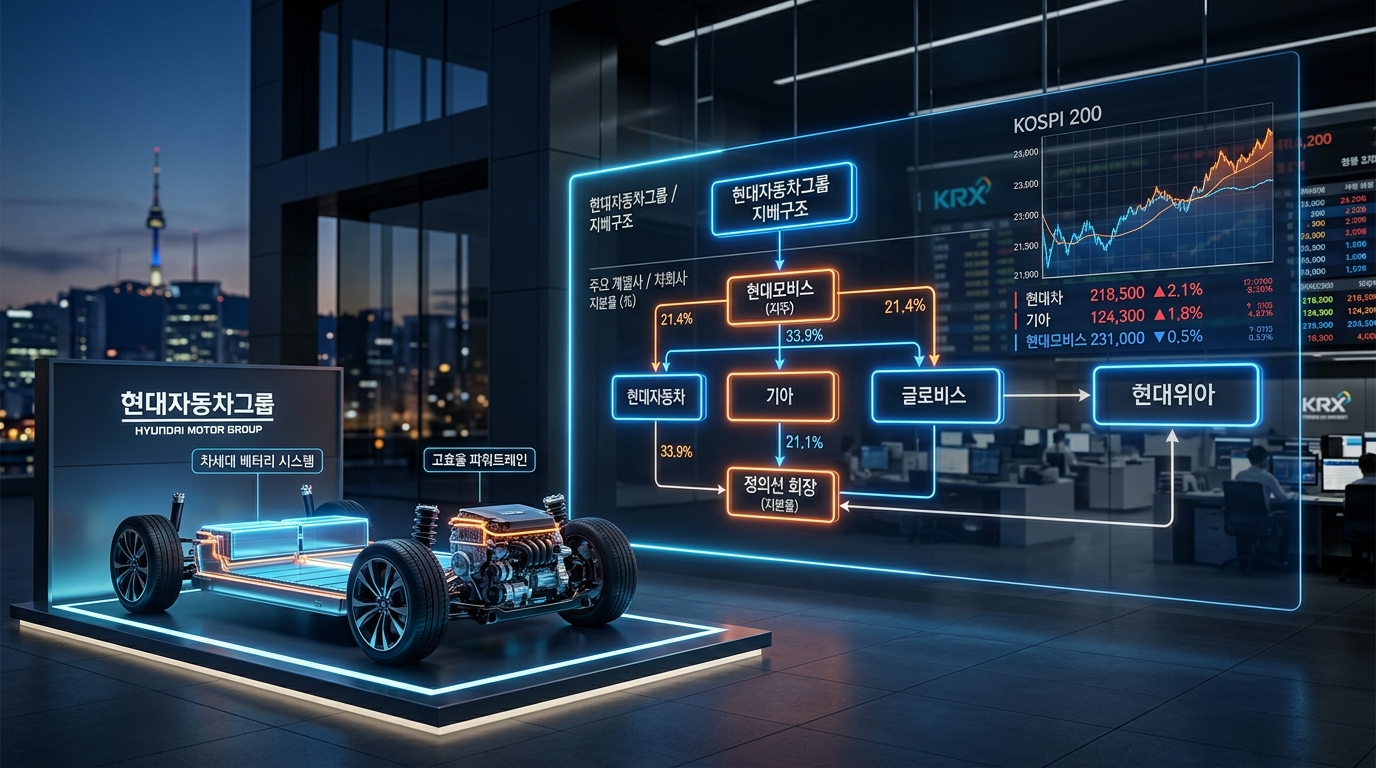
Hyundai Mobis serves as the central core at the very top of Hyundai Motor Group's governance structure and the backbone of its auto parts supply chain.
Even amid the global electric vehicle (EV) "chasm" (a temporary slowdown in demand before mainstream adoption), the company is precisely tuning its timeline to achieve break-even (BEP) by shedding non-core assets and pivoting toward hybrid powertrains.
Currently, the equity market shows the KOSPI at 5,552.74, KOSDAQ at 781.97, and NASDAQ at 26,430.89, with the USD/KRW exchange rate settling at 1,327.60 KRW.
According to Daily Stock's proprietary Fear & Greed Index, the KOSPI is in the "Extreme Fear (6.7)" stage—indicating peak risk aversion compared to "Extreme Fear (12.4)" one week ago, "Fear (29.2)" one month ago, and "Extreme Fear (12.4)" three months ago.
Amid such subdued market liquidity and sentiment, visibility into Hyundai Mobis's turnaround to electrification profitability and the progress of corporate governance restructuring have emerged as the primary determinants for its mid- to long-term valuation rerating.
Current Status Overview
Hyundai Mobis's share price for the session remains unconfirmed (based on the latest verified figure), while recent market attention has zeroed in on its aggressive portfolio restructuring.
The company decided to spin off its low-margin, non-core lamp business through a physical division and sell it to global auto parts maker OPmobility, accelerating operational streamline efforts.
Due to global automakers moderating the pace of pure battery electric vehicle (BEV) rollout, the electrification division's BEP milestone has been pushed back relative to earlier forecasts.
However, losses are narrowing gradually as affordable new vehicle models enter the European market and shipments to non-captive customers, such as Volkswagen (VW), materialize.
Meanwhile, large-cap KOSPI shares are broadly experiencing a liquidity vacuum under the USD/KRW rate of 1,327.60 KRW, exacerbated by foreign selling in index futures.
With the Bank of Korea's policy rate path and trade import-export indicators showing signs of a slowdown, market focus is centering on the downside resilience of Hyundai Mobis, supported by its highly stable cash-generative After-Sales (A/S) parts division.
Financial Analysis
Hyundai Mobis’s undisputed cash cow remains its global A/S parts business.
Underpinned by an expanding global unit-in-operation (UIO) base, steady demand for high-margin replacement parts, and past tariff settlement refunds, the division consistently defends robust operating margins each quarter.
Conversely, the Module and Electrification divisions have faced margin pressures stemming from fixed-cost overheads and underutilized global EV production facilities.
Nevertheless, as marginal businesses are restructured—such as transferring the fuel cell business and selling off the automotive lamp division—fixed-cost reductions are becoming increasingly visible.
| Division | Recent Performance Trends & Key Variables | Profitability Outlook & Drivers |
|---|---|---|
| **A/S Parts** | Maintains overwhelming mid-20% operating margins; solid FX hedge | High-margin product mix persists; acts as stable cash engine |
| **Module / Core Parts** | Increasing share of electronics (ADAS, etc.); buffers affiliate production swings | Gradual margin gains driven by growing non-captive deliveries |
| **Electrification** | Sluggish utilization due to EV chasm; recurring operating losses | Targeting BEP around 2027–2028; supplemented by hybrid component orders |
| **Financial Health** | Strong net cash position; generates multi-trillion KRW operating cash flow annually | Sufficient financial muscle to handle new electrification plant CapEx |
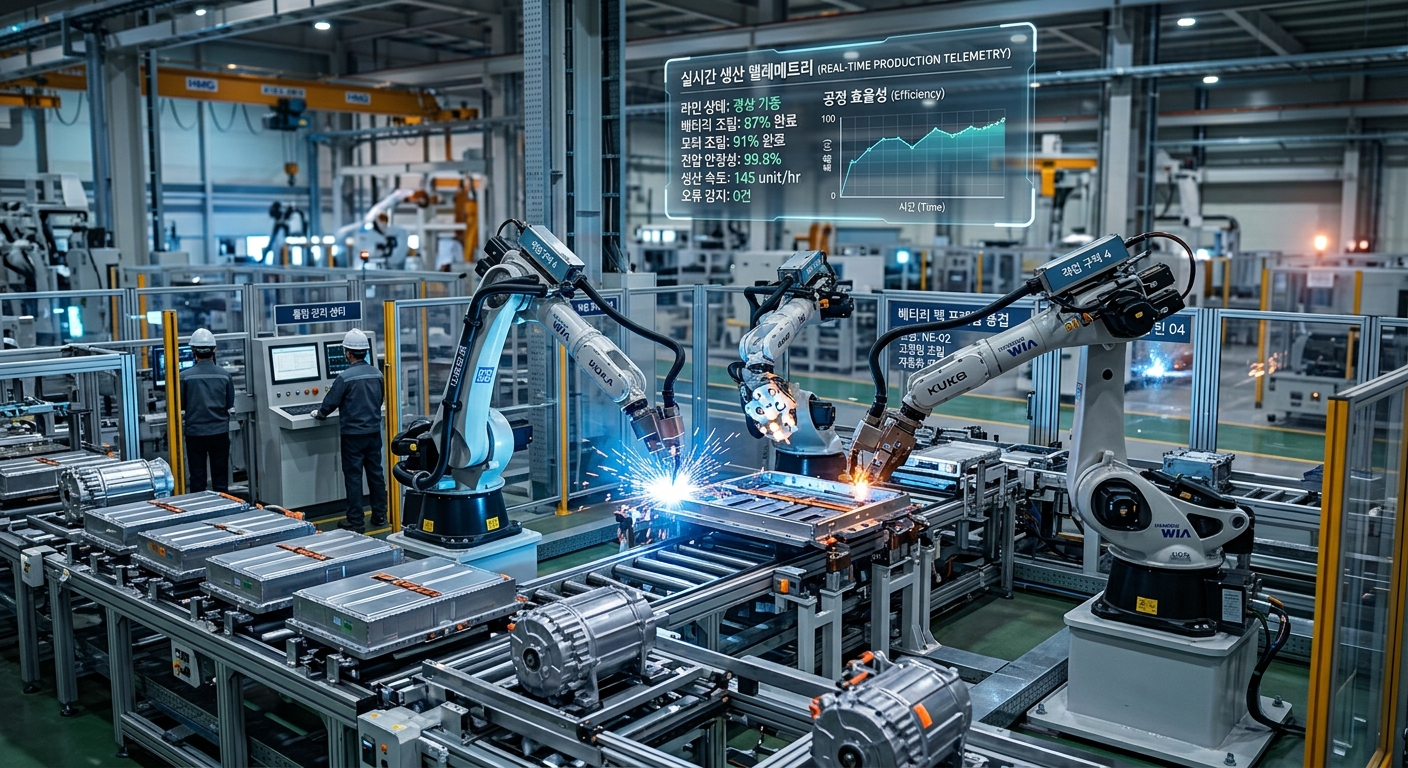
Full-scale operation of European local plants and flexible manufacturing of hybrid vehicle parts at the North American Metaplant will be decisive in improving fixed-cost absorption for electrification.
The massive cash flow generated by the A/S division serves as an effective cushion for ongoing capital expenditures in electrification.
Valuation
Automotive large caps within the KOSPI 200 currently trade at deeply discounted valuations compared to global peers.
While major global OEMs and Tier 1 auto suppliers trade at P/E multiples of 8x to 12x, Hyundai Mobis trades near its historical trough at a P/B multiple of around 0.5x to 0.6x.
This reflects substantial value discounts applied across domestic large caps, particularly with the KOSPI Fear & Greed Index lingering in "Extreme Fear (6.7)" while NASDAQ sits at "Fear (23)."
The prevailing market consensus is that the value of Hyundai Mobis's 22%+ equity stake in Hyundai Motor Company combined with the monopolistic enterprise value of its A/S division alone accounts for a significant portion of its current market capitalization.
If the electrification segment advances beyond simple pack assembly into integrated electronics control units and next-generation software/semiconductor architectures, valuation multiple expansion could follow.
Analysts observe that valuation normalization could unfold once non-core asset sales are finalized and global non-captive order revenues begin contributing directly to consolidated earnings.
Expert and Institutional Analysis
Securities analysts have gradually deferred their projected timeline for Hyundai Mobis's electrification BEP turnaround to around 2027–2028.
While a short-term slowdown in BEV adoption is inevitable, loss reductions should become prominent as mass production of Battery System Assemblies (BSA) for global OEMs such as Volkswagen begins in earnest.
Another critical pillar closely watched by institutional investors is Hyundai Motor Group’s corporate governance restructuring.
Hyundai Motor Group holds the only remaining circular shareholding structure among Korea's top four chaebol conglomerates: Hyundai Mobis → Hyundai Motor → Kia → Hyundai Mobis.

Executive Chair Euisun Chung holds approximately 0.3% of Hyundai Mobis, which represents a crucial variable in any future equity succession or restructuring scenario.
Some market observers speculate that a corporate split-merger model—resembling the attempt in 2018 to spin off the module and A/S businesses—or equity swaps between affiliates could be revisited.
However, a surge in Hyundai Mobis's market value would simultaneously increase the capital outlay required by the controlling family to accumulate shares, posing a complex dilemma in the governance equation.
Analysts stress that preemptive operational business restructuring, such as the sale of the lamp business, must be completed first to build market credibility ahead of any pure ownership restructuring.
Risk Factors
The primary macroeconomic risks to monitor are a global economic slowdown and steep foreign exchange volatility.
If the USD/KRW rate drops sharply from the 1,327.60 KRW level (won appreciation), export-oriented module margins and won-converted operating profits from overseas A/S subsidiaries could decline simultaneously.
Furthermore, rollbacks in EV subsidies and green vehicle policy shifts across major economies could delay capacity utilization recovery at Hyundai Mobis's North American and European electrification facilities.
A pushback of the BEP milestone past 2028 risks prolonging fixed-cost depreciation headwinds.
Lastly, conflicts of interest with public shareholders may arise during potential governance restructuring.
If spin-off ratios or merger values are perceived to impair minority shareholder value, backlash from activist funds and global proxy advisory firms could erode any potential governance premium.
Investment Perspective
Hyundai Mobis presents two distinct faces: a defensive value play and a future mobility components provider.
Although the KOSPI Fear & Greed Index remains depressed at 6.7 and overall market sentiment is trapped in extreme pessimism, the solid profit power generated by the A/S division provides strong downside support.
In the near term, investors should track progress on non-core asset monetization, including the lamp unit sale, as well as improvements in the hybrid component mix.
Over the medium to long term, tangible non-captive electrification wins and a detailed blueprint for dismantling Hyundai Motor Group's circular shareholding are likely catalysts for a valuation rerating.
Consequently, rather than chasing short-term momentum, a phased, conditional perspective that methodically verifies actual revenue conversion from the electrification order backlog alongside governance timelines appears sensible.
Frequently Asked Questions (FAQ)
Q1. When is Hyundai Mobis's electrification business expected to reach break-even (BEP)?
Due to the slowdown in global EV demand, reaching break-even around 2027–2028 is widely cited as the most probable scenario. Nonetheless, operating losses are steadily contracting thanks to battery system supply for European compact EVs and expanded hybrid powertrain components.
Q2. What is the background behind the ongoing sale of the lamp business?
The transaction aims to divest a low-margin unit weighed down by significant R&D personnel costs and CapEx requirements, reallocating core capital and engineering resources toward advanced automotive electronics and software. Selling non-core assets helps drive broad margin improvement across the module segment.
Q3. Why is Hyundai Mobis the focal point in Hyundai Motor Group's governance restructuring?
Hyundai Mobis serves as the de facto holding company by holding an equity stake of over 22% in Hyundai Motor. Securing a controlling stake in Hyundai Mobis is the decisive prerequisite for breaking the circular shareholding chain (Mobis → Hyundai Motor → Kia → Mobis) and solidifying the controlling family's ownership.
Q4. Does a drop in the USD/KRW exchange rate negatively impact Hyundai Mobis's earnings?
Because the company has high foreign sales exposure and exports high-margin A/S components, Korean won appreciation (a falling exchange rate) leads to lower won-denominated operating profit. However, stabilized raw material import costs and higher local production overseas help cushion the impact.
Q5. How is Hyundai Mobis linked to Boston Dynamics' robotics business?
Hyundai Mobis plans to develop and supply core precision actuators and drive components for next-generation humanoid robots like Atlas. Leveraging existing automotive steering and motion control technologies limits incremental CapEx requirements, positioning robotics as a promising new growth driver beyond 2027.