Hello, this is Daily Stock, delivering key turning points in global technology and the Nasdaq market.
Executive Summary
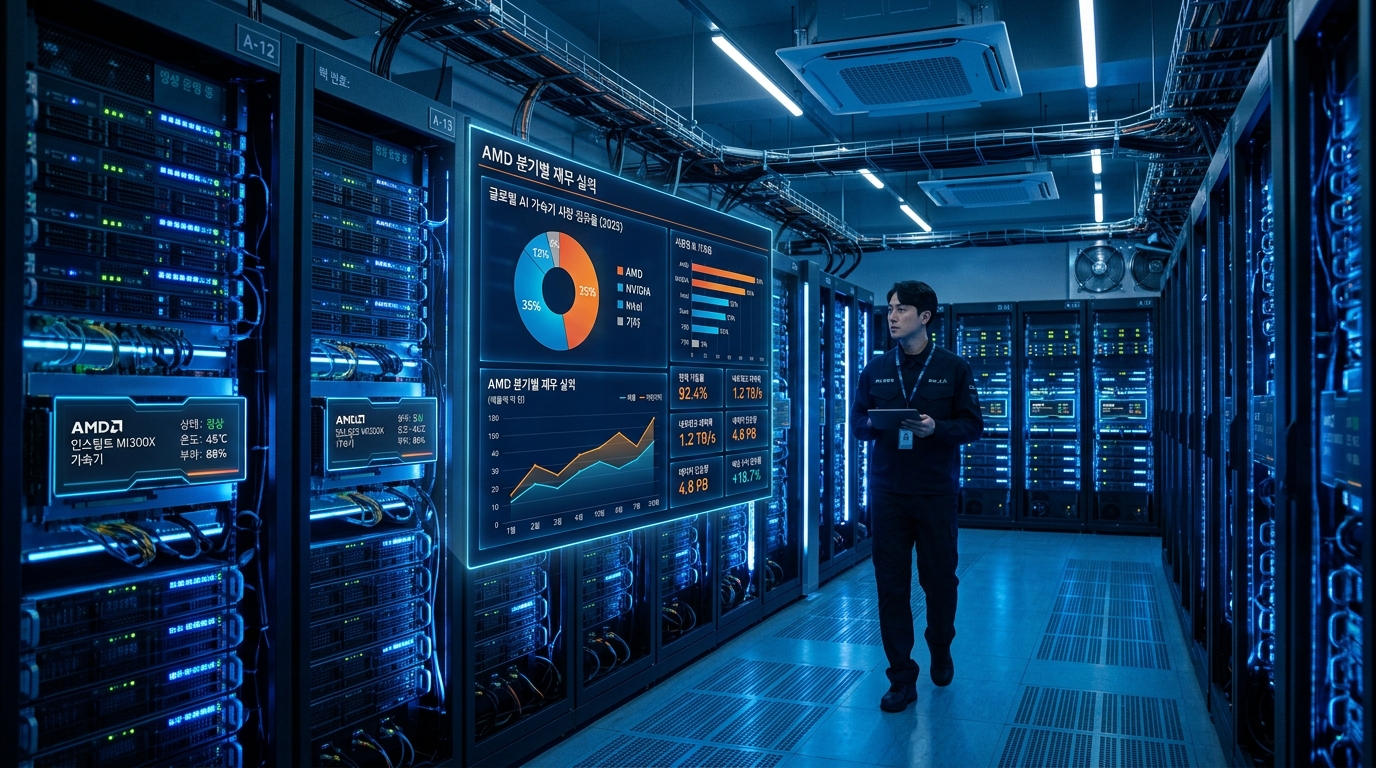
AMD is aggressively securing meaningful market share in the global AI accelerator market as it scales up shipments of the Instinct MI300X and its next-generation lineup.
As AMD absorbs hyperscalers' demand for dual-vendor supply chains in an AI infrastructure market previously dominated by Nvidia, revenue contributions from its Data Center segment are rising sharply.
However, the maturity of its software ecosystem (ROCm) and the pace of Big Tech's adoption of custom application-specific integrated circuits (ASICs) will serve as critical variables for medium- to long-term valuation expansion.
Current Market Overview
As of morning trading on October 20, 2026 (provisional), the Nasdaq Composite is moving around the 26,430.89 level, where overhead valuation pressure and a wait-and-see stance ahead of earnings season remain in a tight tug-of-war.
At the same time, the KOSPI index stands at 5,734.77, the KOSDAQ at 805.05, and the USD/KRW exchange rate is trading at 1,330.50 KRW.
According to Daily Stock's proprietary Fear & Greed Index, the Nasdaq is currently in the "Fear" zone at 23.1, reflecting cooled investor sentiment compared to "Neutral" (46.3) one week ago, "Fear" (30.4) one month ago, and "Fear" (22.3) three months ago.
The KOSPI Fear & Greed Index is also in "Extreme Fear" at 7.4, indicating persistent risk-off sentiment compared to 12.4 one week ago, 29.2 one month ago, and 12.4 three months ago.
While AMD's intraday price reflects high volatility (based on the latest confirmed figures), broader semiconductor volatility is expanding in tandem with rising data center infrastructure capital expenditures (CAPEX) from hyperscalers.
Major cloud customers, including Meta and Microsoft (MSFT), have begun to crack Nvidia's monopoly by adopting the MI300X and subsequent rack-scale solutions to reduce inference costs.
Amid trends across the Philadelphia Semiconductor Index (SOX) and the Nasdaq 100, the market is closely watching whether AMD's actual market penetration can be substantiated in quarterly earnings results.
Financial Analysis
AMD's financial fundamental strength has firmly transitioned away from its legacy PC and gaming businesses toward its data center platform.
With robust demand for EPYC server CPUs and the full-scale revenue recognition of MI300X accelerator shipments, Data Center quarterly revenue continues to post record growth.
| Segment | Key Characteristics & Trends | Earnings Impact |
|---|---|---|
| **Data Center** | EPYC market share expansion and volume mass production of MI300X | Primary driver of corporate operating profit and operating margins |
| **Client (PC)** | Gradual recovery amid initial AI PC adoption tailwinds | Generates steady quarterly cash flows |
| **Gaming & Embedded** | Late-stage console cycle and upstream inventory adjustments | Gradually diminishing share of total corporate revenue |
| **Profitability Metrics** | Non-GAAP Gross Margin settling in the mid-50% range due to higher AI chip mix | Evident fixed-cost absorption and visible operating leverage |
Because the average selling price (ASP) per Instinct accelerator unit significantly exceeds that of legacy graphics chipsets, volume growth translates directly into gross margin improvements.
However, advanced packaging (such as CoWoS) and High Bandwidth Memory (HBM) procurement costs remain structural cost factors that partially cap initial margin upside.
Valuation
AMD trades at an elevated forward P/E multiple that reflects both a runner-up premium within the AI hardware value chain and substantial growth potential.
However, tech growth stock multiples have become exceptionally sensitive to fluctuations in the U.S. 10-Year Treasury Yield (US10Y) and the U.S. Dollar Index (DXY).
If Treasury yields face renewed upward pressure, valuation burdens could intensify, especially under scenarios where the monetization of AI infrastructure is delayed.
Concurrently, during periods when the CBOE Volatility Index (VIX) swings sharply, the risk of a multiple de-rating across Nasdaq 100 growth stocks cannot be ruled out.
Therefore, to justify the valuation multiples assigned by the market, AMD must demonstrate not just volume shipments of the MI300X, but continuous upward revisions to its order backlog.
Expert & Institutional Analysis
Major Wall Street investment firms view AMD favorably as the most viable alternative for Big Tech companies seeking to mitigate single-supplier risk in the AI accelerator market.
Firms such as Wedbush and Citigroup assess that the MI300X has secured a competitive total cost of ownership (TCO) advantage in large-scale model inference workloads among major hyperscalers.
Analysts also note that long-term supply visibility has improved as companies like Meta, OpenAI, and Anthropic have included AMD in their roadmaps for next-generation AI infrastructure partnerships.
Conversely, a cautious view persists that narrowing the market share gap with Nvidia may prove challenging as Nvidia accelerates the release cycles of its Blackwell and subsequent architectures.
Institutional investors highlight whether Big Tech's AI CAPEX levels are sustainable and whether AMD can comfortably secure a low-double-digit market share as key benchmarks to monitor.
Risk Factors
The most fundamental risk is the developer lock-in deficit of AMD's ROCm compared to Nvidia's proprietary CUDA software platform.
Although recent ROCm updates have substantially improved framework compatibility, differences in clock management and model flaw utilization (MFU) across massive cluster deployments can reduce real-world operational efficiency.
A second risk is the accelerated internal development of custom ASICs by Big Tech companies.
As more cloud providers collaborate with firms like Broadcom to design proprietary AI accelerators, portions of the merchant silicon accelerator TAM could become fragmented.
Lastly, investors must remain mindful that any macroeconomic slowdown coupled with uncertainty surrounding interest rate cut trajectories could prompt Big Tech to moderate the pace of its AI infrastructure investments.
Investment Perspective
Rather than relying solely on hardware specification comparisons, investors should adopt a phased approach that monitors AMD's real-world commercial penetration across enterprise data centers.
Having moved past the phase of benefiting purely from competitor supply shortages, the pivotal question is whether AMD can protect and expand its market share purely on price-performance and inference efficiency.
From a macroeconomic perspective, a prudent strategy involves monitoring the stability of the U.S. 10-Year yield alongside Daily Stock's Nasdaq Fear & Greed Index, executing staggered entries across volatility spikes.
Confidence in the company's long-term growth roadmap will gain further validation once customer adoption metrics for next-generation integrated rack systems (such as Helios) materialize.
Investor Checkpoint Q&A
Q1. What is the most significant structural differentiator of the AMD MI300X compared to Nvidia?
A. Its advantages in High Bandwidth Memory (HBM3) capacity and memory bandwidth allow it to offer high cost-efficiency per chip, particularly in large language model (LLM) inference workloads.
Q2. How does the maturity of ROCm software compare to Nvidia's CUDA today?
A. Support for major open-source frameworks like PyTorch has improved considerably, allowing standard models to run smoothly. However, optimization and library maturity in ultra-large-scale distributed training clusters remain in a catch-up phase.
Q3. What is the primary motivation for Big Tech companies purchasing AMD AI chips?
A. Supply chain diversification serves as the core driver, enabling hyperscalers to reduce reliance on a single vendor, enhance price bargaining power, and hedge against chronic accelerator supply deficits.
Q4. Which macroeconomic indicators are most sensitive for AMD's stock price?
A. The U.S. 10-Year Treasury Yield (US10Y) and Big Tech's annual CAPEX guidance. As a high-multiple tech stock, AMD is vulnerable to yield spikes and directly impacted by any cuts to cloud capital spending.
Q5. What is the single most critical metric investors must track in quarterly earnings releases?
A. Investors should primarily watch the sequential revenue growth rate of the Data Center segment alongside any upward revisions to full-year Instinct GPU revenue guidance.