
Here is an examination of Meta Platforms' (META) open-source artificial intelligence (AI) strategy and its direct linkage to core digital advertising performance.
Executive Summary
Meta is aggressively expanding a frontier-class open-source ecosystem led by 'Llama 3.1', building its own distinct AI camp. Unlike closed-model approaches, lowering entry barriers attracts developers and enterprises worldwide, aiming to establish its architecture as the de facto technical standard across its platform ecosystem.
Tangible returns from this open-source strategy are directly feeding into the advancement of its primary revenue engine: digital advertising systems. Powered by AI-driven automated advertising solutions such as 'Advantage+' and refined recommendation algorithms, Meta is driving concurrent increases in both ad pricing and ad impressions.
However, massive capital expenditure (CAPEX) plans projected at $130 billion to $145 billion for 2026 place a notable burden on free cash flow (FCF). Amid broader Nasdaq volatility and prevailing macroeconomic interest-rate conditions, whether costly AI infrastructure can continue defending sustainable ad margins remains the primary inflection point.
Current Market Snapshot
As of October 18, 2026, while intraday stock quote data for Meta is pending confirmation (based on latest available tracking), market sentiment surrounding digital ad conditions and AI infrastructure expansion remains sharply divided. The Nasdaq Composite closed at 26,140.03, the KOSPI at 5,668.05, the KOSDAQ at 794.78, and the USD/KRW exchange rate stood at 1,337.80 KRW.
According to Daily Stock's proprietary Fear & Greed Index, the Nasdaq Fear & Greed Index currently sits in the "Extreme Fear" zone at 17.9. This follows shifts from Neutral (46.5) one week ago, Fear (27.3) one month ago, and Fear (23.1) three months ago, pointing to a swift flight from risk assets driven by short-term volatility. The KOSPI is likewise depressed in the Extreme Fear zone (5.3), warranting conservative valuation approaches across global growth equities.
Meta has seized ecosystem leadership by distributing frontier open-source models, including Llama 3.1 405B, across both cloud and on-device environments. Concurrently, Daily Active People (DAP) across the Family of Apps—including Instagram and Facebook—surpassed 3.6 billion, providing a robust traffic foundation to deploy and scale AI capabilities.
Financial Analysis
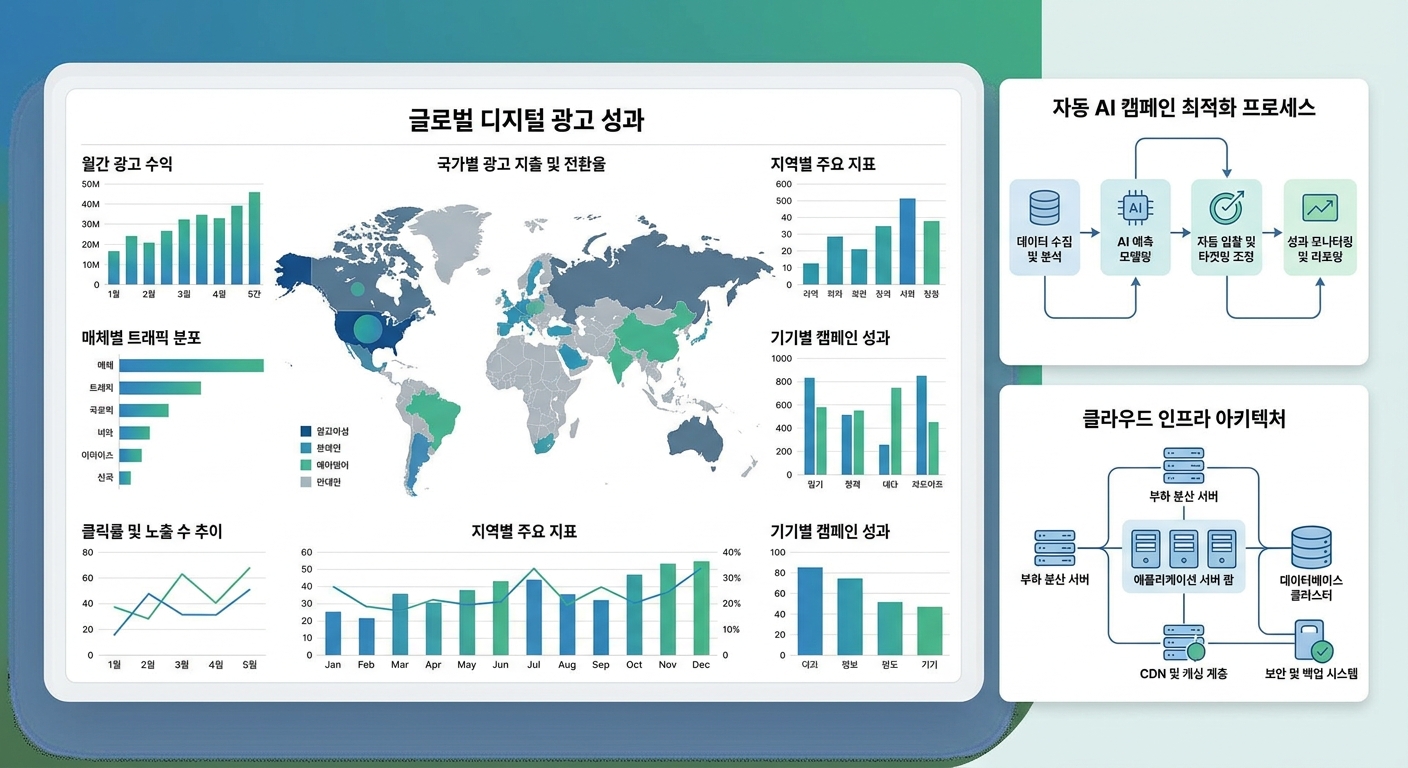
Meta's quarterly financial performance shows visible operational leverage where AI investments directly enhance ad engine efficiency. Total revenue in the most recent quarter reached $60.8 billion, a 28% year-over-year increase, with advertising revenue contributing $59.4 billion to anchor overall top-line growth.
Key qualitative indicators—ad impressions and average price per ad—maintain resilient upward momentum. Notably, the annual run-rate for Advantage+, Meta's machine learning and generative AI-driven campaign optimization suite, reached approximately $75 billion.
| Key Financial & Operating Metrics | FY2025 Performance | 2026 Recent Quarter / Outlook | Notes |
|---|---|---|---|
| Total Revenue | Approx. $200.97 billion | $60.8 billion (+28% YoY) | Near quarterly historical highs |
| Advertising Revenue | Approx. $195.0 billion | $59.4 billion (+27% YoY) | Accounts for over 97% of total revenue |
| Advantage+ Annual Run-Rate | Est. $50 billion range | $75 billion run-rate achieved | AI-based automated optimization suite |
| Annual CAPEX | Approx. $72.2 billion | $130 billion – $145 billion guidance | AI data centers and GPU clusters |
| Operating Margin (OPM) | Approx. 41% – 48% range | Under pressure at 34% – 38% | Increased infrastructure depreciation & headcount costs |
On the cost side, depreciation charges and engineering talent costs tied to data center rollouts and server expansions remain prominent. Operating profit margins, while moderated from peak levels prior to the aggressive CAPEX cycle, remain defended in the mid-to-high 30% range.
Valuation
Meta's valuation profile reflects a dual dynamic when compared to Big Tech peers (Alphabet, Microsoft, Amazon): robust free cash flow generation countered by elevated capital expenditure demands. With its forward price-to-earnings (Forward P/E) ratio typically tracking in the low-to-mid 20s, the stock frequently screens as relatively discounted compared to pure-play AI software entities.
However, valuation multiples display elevated sensitivity to movements in the 10-year US Treasury yield (US10Y) and the US Dollar Index (DXY). When benchmark sovereign yields push higher, elevated discount rates applied to long-duration cash flows can trigger repeated multiple compression among growth stocks undertaking aggressive CAPEX programs.
Relative strength comparisons between the Philadelphia Semiconductor Index (SOX) and the Nasdaq 100 also highlight an ongoing bifurcation between AI infrastructure hardware beneficiaries and software/platform operators. While hardware providers trade on supply-chain backlog execution, Meta faces the operational hurdle of consistently demonstrating monetization through ad ROI enhancements.
Institutional and Expert Analysis
Major Wall Street investment banks assess that Meta's open-source distribution of Llama 3.1 serves over the long term to erode the pricing power of proprietary, closed-platform competitors. By locking developer ecosystems into Llama's architecture, Meta mitigates dependencies on external proprietary models and lowers internal system optimization expenses.
Institutional analysts, including Bank of America (BofA), argue that Meta's primary competitive advantage lies not merely in raw model benchmarks, but in its sophisticated ad delivery engine. Even marginal gains in content recommendation accuracy and ad matching translate directly into substantial incremental ad billings across its multi-billion-user base.
Conversely, more conservative institutions, such as Citi, emphasize the capital payback period of exponentially climbing capital outlays. Analysts caution that if the growth rate of infrastructure maintenance and depreciation surpasses incremental top-line AI monetization, earnings per share (EPS) momentum could face headwinds.
Risk Factors
The central risk factor rests on the capital efficiency of ongoing AI investments and the potential for extended monetization timelines. Elevated annual CAPEX guidance up to $145 billion could quickly pressure corporate margins if macroeconomic softening dampens digital ad pricing.
Regulatory scrutiny also poses operational friction against Meta's personalized advertising algorithms. Enforcement under the European Union's Digital Markets Act (DMA) and stricter data privacy directives limit cross-platform tracking, presenting headwinds to ad pricing across European markets.
Additionally, spikes in the VIX volatility index and lingering macroeconomic uncertainty typically trigger corporate belt-tightening in quarterly marketing budgets. Because the open-source ecosystem itself operates without direct licensing revenue, core ad cash flows must bear the full cost of infrastructure upkeep.
Investment Perspective
Through Llama 3.1, Meta is driving model development costs down industry-wide while securing a direct monetization pipeline via ad performance improvements. The rapid scale of Advantage+ and upgraded algorithmic engines serve as strategic defenses to retain advertisers and solidify platform engagement.
When evaluating investment scenarios, close attention should be paid to the pace at which aggressive capital deployment converts into actual operating income expansion. Maintaining equilibrium between upward revisions to CAPEX guidance and realized ad price increases serves as a foundational condition for valuation rerating.
With the Nasdaq currently navigating an "Extreme Fear" sentiment environment (Fear & Greed Index at 17.9), a prudent stance warrants tracking benchmark interest-rate paths alongside advertiser spend behavior. Market positioning hinges on monitoring two critical pillars: open-source ecosystem reach and the defensive durability of advertising cash flows.
FAQ
Q1. Why does Meta provide Llama 3.1 as open-source software instead of charging for access?
A1. The open-source model aims to neutralize monopolistic pricing by closed-source AI vendors while positioning Meta's framework as the global development standard. Leveraging contributions from the global developer community lowers internal R&D costs and optimizes third-party software for Meta's internal platform infrastructure.
Q2. How does AI technology directly enhance Meta's core digital advertising business?
A2. AI engines power the Advantage+ suite and content recommendation models, optimizing targeting precision and conversion rates to lift advertiser return on investment (ROI). Higher ROI subsequently stimulates overall ad spend and average pricing across the platform.
Q3. What is driving the substantial increase in 2026 capital expenditures (CAPEX)?
A3. The increase is driven by data center expansions at the gigawatt (GW) scale and procurements of high-performance AI accelerators to handle training for next-generation frontier models and broad inference workloads. In-house custom silicon efforts and network upgrades contribute to the $130 billion to $145 billion guidance band.
Q4. What is the historical relationship between the 10-year US Treasury yield and Meta's valuation?
A4. As a large-cap growth stock committing heavy capital to long-term infrastructure, rises in long-term yields lift the discount rate on distant cash flows, exerting downward pressure on valuation multiples. Conversely, yield stabilization generally supports multiple recovery when paired with steady advertising cash generation.
Q5. How significant is the regulatory risk from the European Union on Meta's earnings?
A5. Regulations that constrain the aggregation of consumer data across platforms impair targeting granularity, presenting downward pressure on regional ad pricing across the EU. While Meta continues to roll out generative contextual analysis tools to mitigate data restrictions, regulatory shifts remain an active risk factor to monitor.