
Hello, this is Daily Stock, delivering the core context behind global tech and capital markets.
Executive Summary
Applied Materials (AMAT) has established Advanced Packaging as its primary next-generation growth engine, officially targeting mid-to-long-term revenue of more than $5 billion in this segment.
As scaling down planar process nodes encounters physical limits, surging demand for High Bandwidth Memory (HBM) and 2.5D/3D heterogeneous integration (chiplets) is driving a steep rise in orders for relevant etch, deposition, and chemical mechanical planarization (CMP) equipment.
As of intraday trading on October 16, 2026 (preliminary), the Nasdaq Fear & Greed Index stood at 31.5 (Fear), while the KOSPI Fear & Greed Index registered 4.8 (Extreme Fear), reflecting persistent macroeconomic liquidity caution.
As Big Tech's massive AI capital expenditure (CAPEX) pivots beyond front-end semiconductor fabrication to address packaging bottlenecks, AMAT's dominance in turnkey solutions—bolstered by its inline hybrid bonding partnership with Besi—is undergoing a comprehensive re-rating.
Current Market Context
The most pressing challenges facing global foundries and memory manufacturers in AI accelerator production are interconnect bandwidth and thermal dissipation.
With the cost of planar die shrinking escalating sharply, multi-die horizontal and vertical packaging processes have become the decisive battleground determining total chip performance.
During its SEMICON West 2026 presentation, AMAT revealed that its advanced packaging-related revenue has been expanding at an annual growth rate exceeding 70%.
The company also projected that the three pillars of leading-edge logic, DRAM, and advanced packaging will drive approximately 75% of global wafer fab equipment (WFE) spending growth through 2030.
Currently, the Nasdaq is fluctuating around the 26,713.03 level, experiencing continued volatility driven by sensitivity to 10-year US Treasury yields and a strong US Dollar Index (DXY).
While the broader Philadelphia Semiconductor Index (SOX) pauses amid ongoing debates over AI monetization return profiles, packaging equipment vendors are demonstrating relative defensiveness backed by confirmed order backlogs.
| Indicator | Key Data & Metrics (As of intraday Oct 16, 2026, preliminary) |
|---|---|
| KOSPI / Nasdaq Index | KOSPI: 5,554.22 / Nasdaq: 26,713.03 |
| USD/KRW Exchange Rate | 1,342.50 KRW |
| Daily Stock Fear & Greed Index | KOSPI: 4.8 (Extreme Fear) / Nasdaq: 31.5 (Fear) |
| AMAT Advanced Packaging Revenue Target | Mid-to-long-term target of $5B+ |
| 2030 Management Guidance | Non-GAAP Gross Margin: 54%, Operating Margin: 40% target |
Financial Analysis
AMAT’s recent fiscal Q3 results demonstrated that the buildout of AI infrastructure is translating directly into tangible equipment deliveries and robust cash generation.
Third-quarter revenue rose 25% year-over-year to $9.12 billion, marking the largest sequential quarterly expansion in the company's history.
On the profitability front, Non-GAAP operating income reached $3.1 billion, yielding an operating margin of 34.0%, while adjusted EPS jumped 41% year-over-year to $3.50.
In particular, DRAM segment equipment revenue—which includes high-margin demand for HBM advanced packaging—surged 52% year-over-year, leading top-line growth.
Operating cash flow exceeded $3.0 billion. Following $707 million in capital expenditures (CAPEX), AMAT generated approximately $2.3 billion in free cash flow (FCF).
The company continues to adhere strictly to its capital allocation policy of returning 80% to 100% of free cash flow to shareholders via share buybacks and dividends.
Valuation
Following a rapid rally in 2026, AMAT’s stock has entered a period of short-term valuation digestion.
The forward price-to-earnings (Forward P/E) multiple currently sits near the upper end of its five-year historical range, leaving it vulnerable to multiple compression should macroeconomic variables shift.
If the 10-year US Treasury yield remains elevated, the discount rate burden across growth equities could rise. However, AMAT benefits from a more solid valuation floor than pure-play software growth equities thanks to its superior FCF generation.
The central re-rating narrative hinges on whether AMAT can successfully shift its market identity from a traditional cyclical equipment manufacturer to an indispensable AI hardware materials and process platform provider.
If the advanced packaging division secures its targeted $5 billion run rate and services revenue exceeds $12 billion by 2030, the company is likely to sustain its valuation multiple premium on expanded earnings power.
Institutional and Analyst Insights
Major Wall Street investment banks note that AMAT has evolved far beyond a non-lithography equipment supplier into an indispensable backbone of the next-generation hybrid bonding ecosystem.
The integrated inline system—co-developed with Netherlands-based Besi, encompassing dielectric deposition, CMP, and ultra-high-precision die placement—is actively being deployed across TSMC’s 3D packaging lines and next-generation lines of leading memory manufacturers.
Global investment banks such as Morgan Stanley and Goldman Sachs highlight that surface planarization (CMP) tolerance thresholds are narrowing dramatically during the integration of next-gen HBM and logic chiplets.
Analysts largely expect AMAT’s Opta CMP and atomic layer etching technologies to form a wide competitive moat, allowing the company to capture an additional 2 percentage points or more of market share from competitors.
Conversely, some institutions voice a more cautious perspective, pointing out that despite strong long-term growth prospects, constraints such as customer cleanroom capacity shortages and delays in power grid infrastructure could potentially push back short-term delivery timelines.
Risk Factors
The most direct risk stems from intensifying US-China geopolitical tech tensions and tightening semiconductor equipment export controls targeting China.
Because AMAT retains a measurable level of revenue exposure to the Chinese market, any further restrictions extending into mature/legacy nodes could trigger downward revisions to short-term backlogs.
Second is the risk of a delayed return on investment (ROI) across Big Tech’s AI data center CAPEX.
Should monetization from end-user AI software and enterprise agent services slow down, fabless chipmakers such as Nvidia and Broadcom might scale back outsourced packaging volume, leading to deferred or canceled equipment orders.
Finally, yield stabilization rates during mass manufacturing of 3D packaging and hybrid bonding pose operational risks.
If elevated unit costs compared to microbump packaging and thermal expansion challenges are not swiftly addressed, the timeline for commercial equipment revenue recognition could trail market expectations.
Investment Takeaway
Applied Materials stands at the vanguard of the advanced packaging transition, which serves as the primary technical lever to circumvent the slowdown of Moore's Law.
As vertical HBM stacking and 2.5D/3D silicon interposer deployments expand, demand for AMAT's etching, thin-film deposition, and precision planarization portfolios is poised for structural expansion.
With the Nasdaq Fear & Greed Index at 31.5 (Fear) and the KOSPI reading 4.8 (Extreme Fear), market sentiment remains risk-averse.
In the near term, rate volatility and quarterly timing shifts in customer fab tooling schedules may trigger price fluctuations, favoring a phased dollar-cost-averaging approach.
Critical inflection points to monitor going forward include release cycles for next-generation AI accelerators from hyperscalers and the formal transition by top memory manufacturers to hybrid bonding in 16-high (and above) HBM stacks.
Investor Checkpoint Q&A
Q1. What is Applied Materials' core competitive edge in the advanced packaging market?
A1. As the distinction between front-end and back-end manufacturing blurs, AMAT holds a unique capability to deliver end-to-end processing portfolios—including thin-film deposition (PVD/CVD), chemical mechanical planarization (CMP), and advanced etch—on unified, turnkey equipment platforms.
Q2. Why is hybrid bonding regarded as an essential technology for next-generation AI processors?
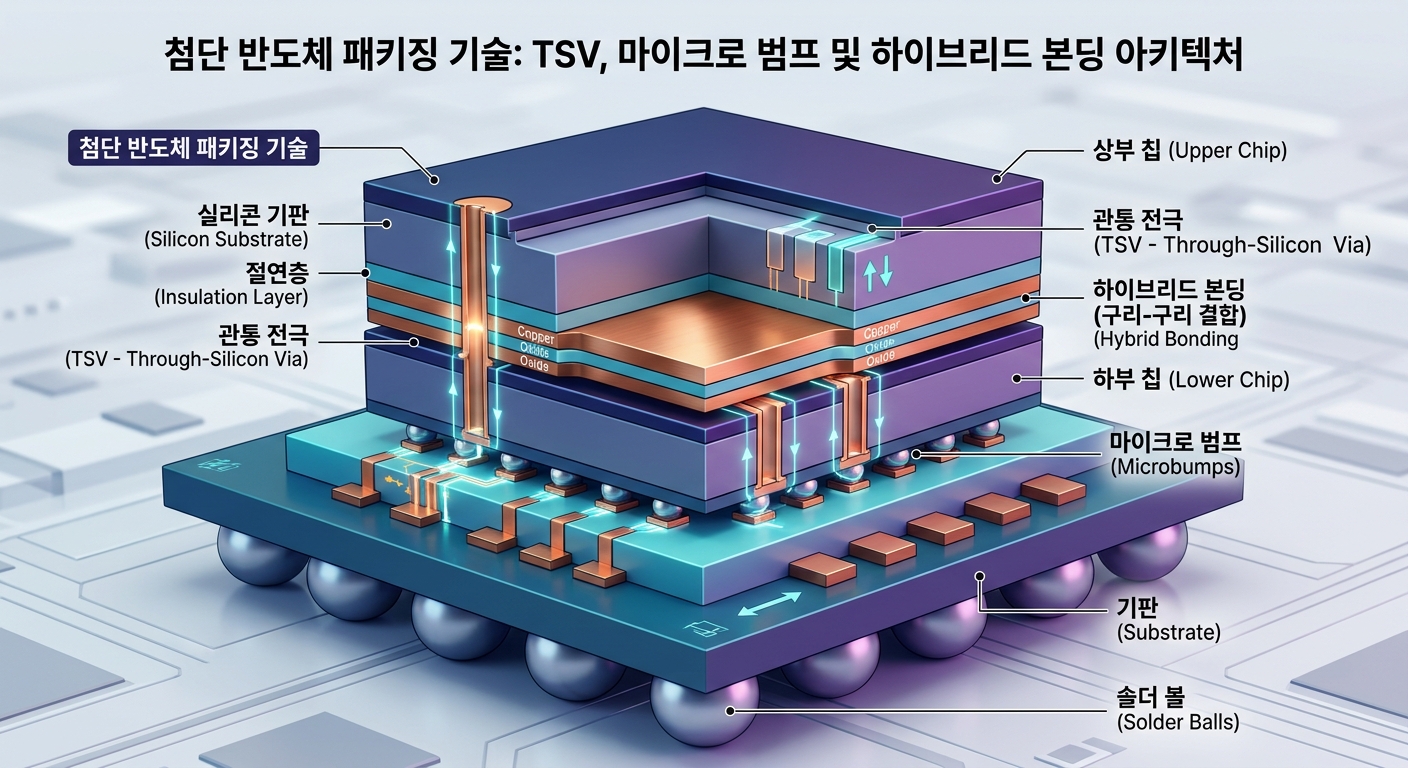
A2. Traditional microbump architectures encounter physical limitations when scaling interconnect pitches below 10 micrometers. Hybrid bonding establishes direct copper-to-copper (Cu-Cu) connections, dramatically slashing latency and power consumption while maximizing interconnect bandwidth.
Q3. How does the partnership with Besi specifically enhance AMAT's performance?
A3. By pairing Besi’s ultra-high-precision die bonders with AMAT’s surface preparation and planarization tools into a unified inline system, the alliance establishes an early leadership position in supplying next-generation 3D packaging lines to foundries and integrated device manufacturers (IDMs).
Q4. Which macroeconomic indicators warrant the closest scrutiny?
A4. The trajectory of the 10-year US Treasury yield, the US Dollar Index (DXY), and quarterly capital expenditure (CAPEX) guidance from Big Tech hyperscalers serve as the primary macro determinants directing semiconductor equipment order cycles.
Q5. How should investors navigate short-term equity volatility?
A5. Due to the project-driven nature of equipment bookings, quarterly earnings can fluctuate depending on customer cleanroom readiness. Investors are advised to look past quarterly delivery noise and instead track structural gains in wafer fab equipment (WFE) market share alongside AMAT’s progress toward its cumulative packaging revenue targets.