
Hello, this is Daily Stock, delivering in-depth analysis of macro market contexts and policy environments for listed companies.
Executive Summary
In 2026, the South Korean stock market is navigating a major turning point in its taxation structure, driven by the finalized abolition of the financial investment income tax and the full-scale implementation of separate taxation on dividend income from high-dividend companies.
With the progressive tax burden under comprehensive financial income taxation—which peaks at up to 49.5% including local income tax—being reduced to a separate taxation special rate of 14% to 30% for qualifying high-dividend companies, incentives are growing for major domestic individual capital to flow back into equity markets.
With the KOSPI index hovering around 5,668.05 on October 16 and the Daily Stock Fear & Greed Index at 6.6, indicating an "Extreme Fear" zone, these tax reforms emerge as a key catalyst to ease supply-demand distortions around year-end ex-dividend dates and test downside support for large-cap KOSPI dividend stocks.
Current Market Overview
On October 16, the domestic equity market closed as volatility in foreign futures trading drove KOSPI movements, while the USD/KRW exchange rate fluctuated around 1,332.30.
With the repeal of the financial investment income tax finalized, the structural year-end selling pressure historically driven by major individual investors seeking to avoid capital gains taxes has eased considerably.
Additionally, as special separate taxation provisions on high-dividend companies under the Restriction of Special Taxation Act gain traction, an environment has formed where corporate shareholder return policies—such as increasing dividend payout ratios and treasury share cancellations—directly link to share price re-ratings.
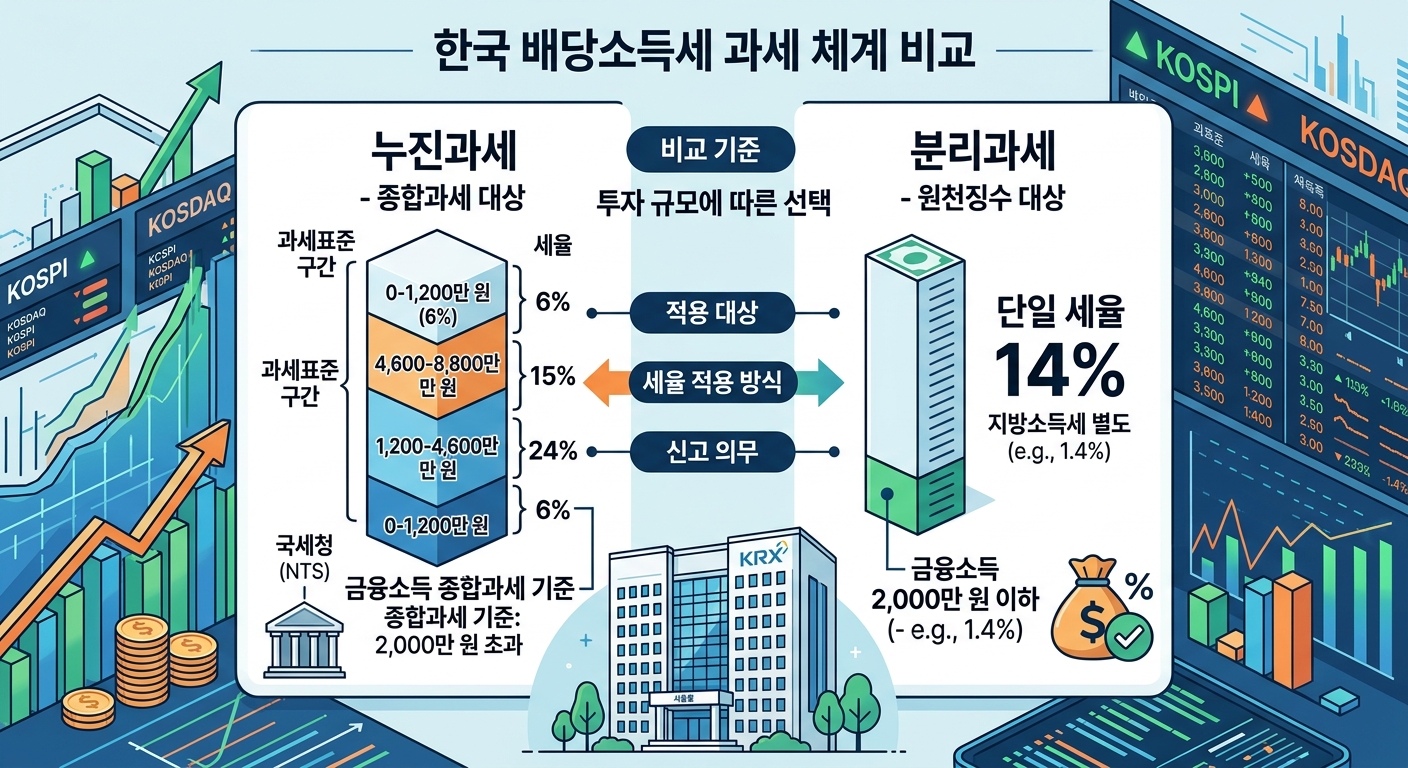
| Classification | Previous Comprehensive Financial Income Taxation | Special Separate Taxation on High-Dividend Companies |
|---|---|---|
| **Eligible Companies** | All listed corporations (general dividends) | Companies with a dividend payout ratio of 40%+ or a dividend increase of 5%+ compared to the previous 3-year average |
| **Taxation Method** | Combined with other income if exceeding KRW 20 million per year | Excluded from other income aggregation; optional withholding-based tiered separate taxation |
| **Tax Rate Structure** | Basic 14% withholding tax, up to 45% under progressive comprehensive taxation (local tax separate) | Under KRW 20M: 14%; under KRW 300M: 20%; under KRW 5B: 25%; exceeding KRW 5B: 30% |
| **Market Supply-Demand Impact** | Pressure from year-end ex-dividend avoidance and profit-taking sell-offs | Stronger incentive for high-net-worth individuals to hold dividend stocks long-term, supporting large-cap liquidity |
Financial Analysis
To meet the criteria for separate taxation on dividend income, major large-cap KOSPI companies are actively presenting capital allocation policies anchored in free cash flow (FCF).
Financial holding companies and leading domestic automakers, in particular, are committing to Common Equity Tier 1 (CET1) ratio management and targeting total shareholder return (TSR) rates of 35% to 50%, consistently exceeding baseline dividend payout requirements.
Conversely, large-cap semiconductor names exhibit quarterly dividend variability driven by massive advanced fab capital expenditures (CAPEX) and global tech industry cycles, requiring closer cash flow scrutiny to evaluate whether they can sustain high-dividend qualification criteria.
The Bank of Korea's policy rate trajectory alongside import/export trends also serve as fundamental indicators determining corporate interest expenses and operating profit margins, which ultimately govern real distributable dividend resources.
Valuation
The 12-month forward price-to-book ratio (PBR) of KOSPI 200 large caps remains in a pronounced discount territory compared to major developed market indices and the Nasdaq (currently at 26,713.03).
Tax reforms open up possibilities to address structural issues historically cited as core drivers of the "Korea Discount"—specifically weak shareholder returns and dividend avoidance among major shareholders and wealthy individuals caused by high dividend tax rates.
For high-dividend financial and holding companies on the KOSPI yielding 4% to 6%, eligibility for separate taxation enhances after-tax yields, increasing their relative appeal against fixed-income yields.
This provides a structural backdrop for valuation re-ratings in large-cap KOSPI value stocks with abundant capital reserves, compared to small- and mid-caps with limited dividend capacity.
Expert and Institutional Analysis
Market analysts assess that the abolition of the financial investment income tax and the implementation schedule for separate dividend taxation establish a positive foundation for medium- to long-term market liquidity inflows.
Institutional investors anticipate that foreign passive capital and long-term domestic institutional funds will first anchor into sectors demonstrating stable earnings power, including large-cap financials, telecommunications, and auto manufacturers.
However, foreign institutional investor flows remain sensitive not only to tax policies but also to the USD/KRW exchange rate (currently at 1,332.30), the Korea-U.S. interest rate differential, and semiconductor export prints.
Because net foreign futures buying continues to serve as a leading indicator for cash equity flows, the prevailing consensus holds that macro stabilization must accompany tax incentives for policy tailwinds to fully translate into sustained market inflows.

Risk Factors
The most prominent risks center on global economic slowdown concerns and capital outflows triggered by sharp exchange rate volatility.
A spiking USD/KRW rate could prompt foreign passive selling to hedge against foreign exchange losses, applying downside pressure to the benchmark index that could overwhelm positive fundamental tax incentives.
Furthermore, because the separate dividend taxation benefit requires companies to maintain or grow their dividends relative to the prior fiscal year or meet payout thresholds, businesses experiencing sharp cyclical profit declines risk losing eligibility.
Uncertainty regarding domestic and foreign policy rate paths and geopolitical tensions, including trade disputes, also lower earnings visibility for export-heavy KOSPI bellwethers.
Investment Perspective
The KOSPI Fear & Greed Index currently stands at 6.6, indicating "Extreme Fear"—a steep contraction in market sentiment compared to one week ago (25) and one month ago (28.2).
When broad market fear peaks, phased accumulation strategies focused on quality large-cap names with verified tax incentives and dividend visibility are typically more prudent than aggressive short-term directional trades.
With capital gains tax overhang resolved via the repeal of the financial investment income tax, investors are encouraged to selectively screen for leading Value-Up names that definitively satisfy high-dividend separate taxation criteria.
Portfolio management should prioritize defensive cash flows, with close monitoring of whether the USD/KRW stabilizes in the 1,330 range alongside shifts in foreign cumulative futures positioning.
FAQ
Q1. Does separate taxation on high-dividend corporate income apply uniformly to all listed stocks?
No. The special taxation applies only to dividends paid by eligible listed corporations that either maintain a dividend payout ratio of 40% or higher, or achieve a payout ratio of 25% or higher while increasing cash dividends by at least 5% compared to their previous three-year average.
Q2. How are individual capital gains taxes applied now that the financial investment income tax is abolished?
With the full repeal of the financial investment income tax, broad taxation concerns regarding capital gains on general listed stocks have been eliminated, maintaining the existing capital gains tax framework applicable primarily to major shareholders.
Q3. What is the real tax-saving benefit for high-net-worth individuals choosing separate taxation?
Instead of being subjected to progressive comprehensive taxation reaching up to 45% (49.5% including local tax) on financial income exceeding KRW 20 million, investors can opt for separate tax rates between 20% and 30%, resulting in substantially larger tax savings as the taxable income base grows.
Q4. How does the USD/KRW rate in the 1,330 range influence foreign investor flows?
A higher exchange rate can prompt foreign selling due to concerns over short-term currency losses; however, when combined with attractive dividend yields and depressed valuations, it can also incentivize bargain hunting.
Q5. How should investors approach dividend equities during an 'Extreme Fear' zone on the Daily Stock index?
A Fear & Greed Index reading of 6.6 reflects severe risk aversion. Consequently, a phased accumulation strategy focused on quality large-cap stocks with reliable dividend yields and tax advantages is a more balanced approach than employing high leverage purely for speculative capital gains.