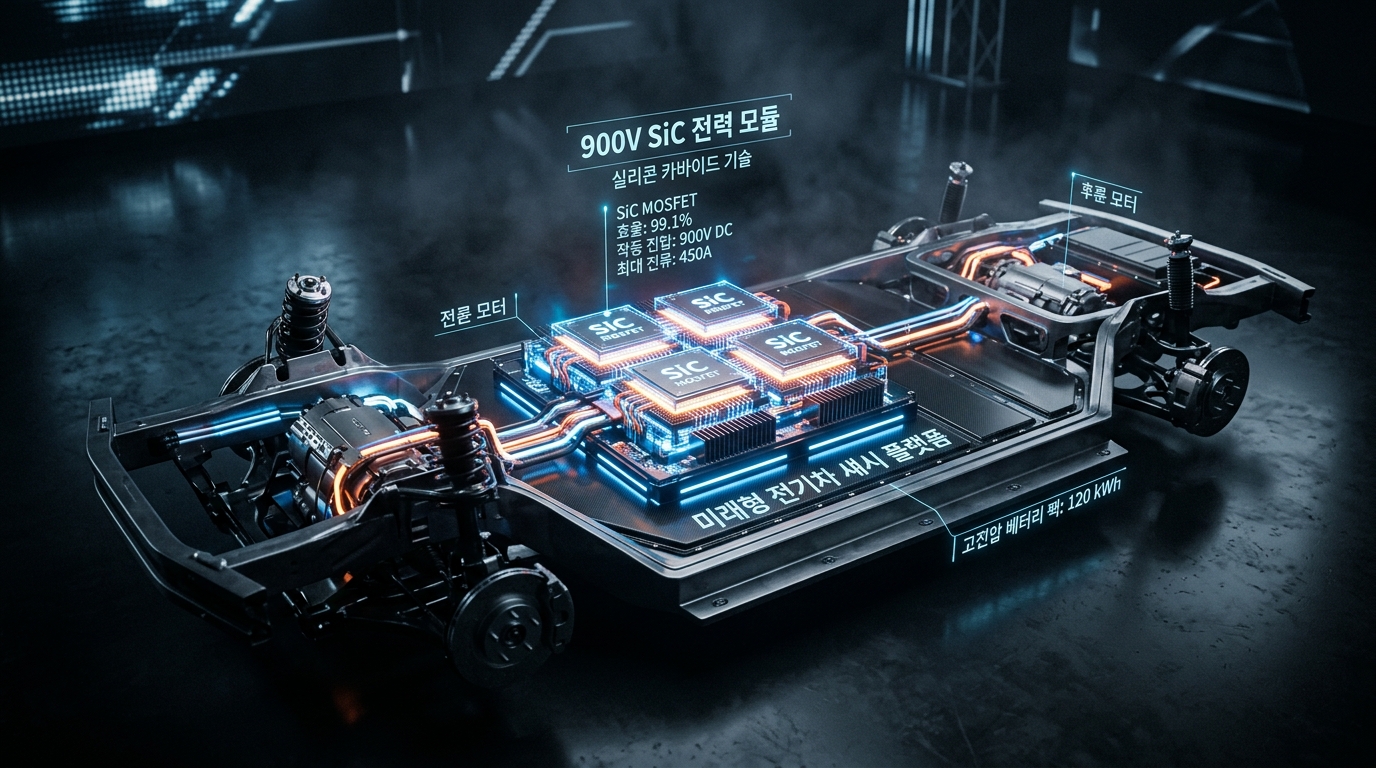
Emerging from the prolonged tunnel of the electric vehicle (EV) chasm and legacy semiconductor inventory adjustments, onsemi (ON) is establishing the foundation for an earnings turnaround driven by rebounding silicon carbide (SiC) power semiconductor utilization rates and high-voltage platform design wins in the automotive sector.
Key Takeaways
onsemi has officially signaled an exit from its bottom, ramping manufacturing fab utilization rates back to around 83% after dropping to the 70% range amid slowing EV demand.
With new EliteSiC design wins materializing for 900V high-voltage platforms from major automakers such as China's Geely and NIO, automotive SiC revenue from China is expected to surge by 60% to 70% year-over-year.
In addition, demand for high-efficiency power semiconductors regulating massive power consumption in AI data centers is growing at a rapid pace of over 100% annually, providing an additional cash generator alongside automotive applications.
However, borrowing costs sensitive to macroeconomic interest rates (US10Y) and the moderated pace of the global transition toward battery electric vehicles remain key variables testing onsemi's medium-to-long-term valuation re-rating.
Current Status Overview
onsemi posted Q2 quarterly revenue of $1.6035 billion, exceeding market expectations, while Non-GAAP Gross Margin improved to 39.3% thanks to the recovery in utilization.
The company guided for Q3 revenue of $1.65 billion to $1.75 billion with gross margins between 40% and 42%, signaling that the trough in margins is now in the past.
As the global EV market shifts rapidly from 400V architectures to 800V–900V platforms emphasizing ultra-fast charging and high efficiency, both SiC content per vehicle and overall die area requirements are rising.
To curb in-house wafer manufacturing costs, onsemi continues to execute its "Fab Right" strategy by divesting legacy fabs, forecasting annual fixed-cost savings of approximately $35 million.
| Key Metric | Recent Performance & Guidance | Trend (YoY / QoQ) |
|---|---|---|
| Quarterly Revenue (Q2) | ~$1.6035 billion | Met upper guidance range & rebounded QoQ |
| Fab Utilization | ~83% | Up 6%p from 77% in previous quarter |
| Non-GAAP Gross Margin | 39.3% (Q3 Guidance: 40–42%) | Gradual improvement for 4 consecutive quarters |
| China Auto SiC Revenue Outlook | Expected +60% to +70% YoY | Expanded exclusive wins with leading local OEMs |
| Free Cash Flow (FCF) | $425 million (Q2) | Surged ~4x YoY |
Financial Analysis
onsemi's Free Cash Flow (FCF) reached $425 million in the latest quarter, yielding a robust 24% FCF margin on a trailing twelve-month (TTM) basis.
This reflects disciplined financial management that avoided reckless capital expenditure races, keeping CAPEX strictly below 5% of total revenue.
Backed by robust cash generation, the company continues to bolster shareholder returns by repurchasing over $300 million in shares per quarter.
In response to raw material inflation pressures, onsemi has successfully protected profitability through secondary price adjustments across its automotive and industrial segments.
Valuation
With the Nasdaq composite trading near the 27,366.17 level, onsemi continues to command a higher growth premium for its SiC business relative to traditional automotive microcontroller (MCU) peers.
The Nasdaq Fear & Greed Index currently sits in Neutral territory at 45 (compared to Fear at 40 a week ago, Fear at 38.2 a month ago, and Neutral at 48.6 three months ago), indicating a market environment focused on fundamental earnings recovery rather than overheating.
For context, the KOSPI Fear & Greed Index is currently in Fear at 24.4, reflecting a considerably weaker risk appetite than the Nasdaq (compared to Neutral at 40.1 a week ago, Neutral at 50.9 a month ago, and Extreme Fear at 13.1 three months ago).
onsemi's multiple upside is expected to hinge on whether it can be re-rated not just as an automotive component supplier, but as a core beneficiary of high-voltage AI data center power delivery architectures (Power Tree).
Expert & Institutional Insights
Major Wall Street institutions are closely monitoring how the recovery rate of onsemi's fab utilization translates into margin expansion.
UBS analysts noted that every 1 percentage point increase in utilization generates roughly 25 to 30 basis points of gross margin operating leverage, projecting a full-fledged margin expansion cycle beginning in Q4.
Morgan Stanley and Bank of America assessed that despite conservative inventory replenishment among European automakers, dominant SiC module market share within emerging Chinese EV platforms continues to support onsemi's earnings downside.
Furthermore, sentiment remains positive as onsemi's chipsets are being adopted as baseline components across NVIDIA's MGX architecture ecosystem and next-generation hyperscale cloud rack power solutions, fundamentally improving the company's product portfolio mix.
Risk Factors
The most prominent risk is a potential delay in mainstream global battery electric vehicle (BEV) adoption, alongside consumer demand shifting toward plug-in hybrid electric vehicles (PHEVs).
Although PHEVs are also adopting SiC, semiconductor content and silicon area per vehicle are inherently more limited than in pure BEVs.
Elevated levels in the 10-year US Treasury yield (US10Y) and the US Dollar Index (DXY) could weigh on auto financing and consumer affordability for capital goods, thereby slowing the recovery of downstream end-market demand.
Investors must also continuously monitor whether aggressive low-cost pricing from domestic Chinese SiC fabs exerts downward pricing pressure in legacy power semiconductor segments.
Investment Outlook
onsemi is evolving beyond a conventional EV theme play into an essential infrastructure provider for physical AI and data center power grids, where high-voltage, high-efficiency power control is critical.
Having moved past its utilization bottom and lowered fixed overhead via its Fab Right strategy, the company has entered an operating leverage window where operating profit can expand rapidly alongside revenue recovery.
Investors should track US Treasury yields and volatility indices (VIX) while monitoring mass-production schedules for next-generation automotive platforms from major OEM clients.
Rather than chasing rallies aggressively, a phased accumulation strategy as utilization normalization continues to be confirmed in quarterly earnings appears prudent.
Investor FAQ
Q1. Why is the recovery in onsemi's fab utilization rate so crucial?
Semiconductor manufacturing carries significant fixed costs, meaning unit production costs decline sharply as fab utilization climbs. For onsemi, each 1 percentage point increase in utilization historically provides roughly 0.25 to 0.3 percentage points of gross margin improvement.
Q2. What advantages does Silicon Carbide (SiC) offer over traditional silicon?
SiC delivers superior durability under high-voltage and high-temperature conditions while drastically minimizing power loss. This is a critical driver for extending single-charge EV driving range and enabling 900V ultra-fast charging.
Q3. Why is automotive SiC revenue growing despite the overall EV slowdown?
Automakers are prioritizing high-voltage platforms that maximize power efficiency rather than merely increasing battery capacity. With leading Chinese OEMs like Geely and NIO adopting 800V–900V architectures as standard, SiC adoption per vehicle has risen substantially.
Q4. How is onsemi connected to AI data centers?
Server racks supporting large-scale AI model training and inference consume tens of kilowatts (kW) of power, necessitating advanced power control semiconductors to prevent current loss. onsemi is rapidly expanding its footprint by supplying high-efficiency modules to NVIDIA's MGX platform and hyperscale cloud data center power infrastructures.
Q5. What macro indicator should investors monitor most closely?
The 10-year US Treasury yield (US10Y) and OEM vehicle inventory levels. Persistently high interest rates increase auto loan financing burdens, potentially slowing EV penetration growth and directly impacting order volumes for automotive chips.